 Driving Mastery
Road signs
Top 10 UK road signs learners get wrong (and how to remember them)
Ten road signs UK learners often mix up, why each one causes confusion, and simple memory hooks to keep them straight before your theory test.
Practise road signsQuick answer
- Some UK road signs are commonly confused because they look similar or their design is misread.
- The sign's shape and colour carry the meaning: red rings prohibit, blue circles instruct, triangles warn.
- Classic mix-ups include no entry vs no vehicles, the national speed limit sign, and the priority arrow pair.
- Short, repeated recognition practice fixes these faster than re-reading a signs list.
Every driving instructor sees the same handful of signs cause trouble, lesson after lesson. These ten come up again and again — not because learners are careless, but because the signs genuinely look alike, or because their design is easy to misread the first few times. This list comes from instructor experience of what learners often mix up, and each entry ends with a memory hook you can actually use.
1. No entry for vehicular traffic
No entry for vehicular traffic
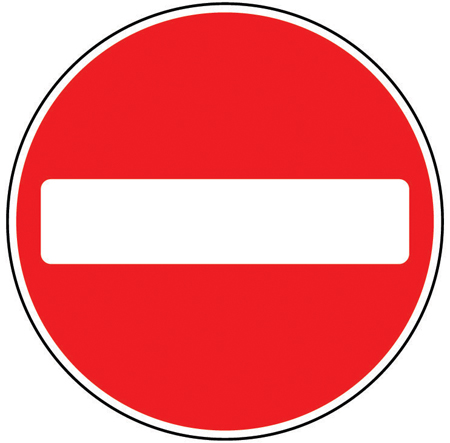
Most learners know this sign is a ban — the trouble is saying exactly what kind. It appears at the end of one-way streets and at junctions where traffic may flow out but not in. Learners often blur it together with the plain prohibition circle (next on this list), and in a multiple-choice question that difference is exactly what gets tested.
Memory hook: the white bar is a closed door. Traffic can come out of that road towards you, but you cannot go in.
2. No vehicles (the empty red circle)
No vehicles except bicycles being pushed
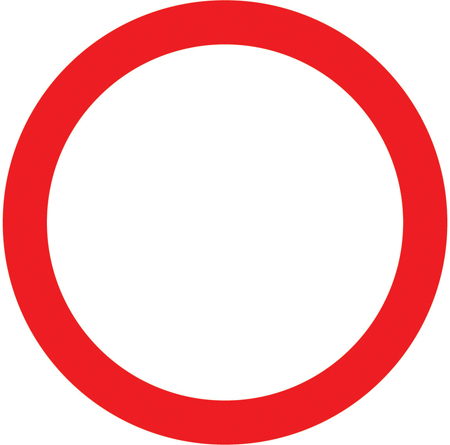
All vehicles prohibited except pedal cycles being pushed by pedestrians, explained
This is the sign learners most often guess wrongly as meaning nothing at all. An empty red circle looks unfinished — so people assume it is a blank or a leftover. In fact the plain red ring is one of the strictest signs on the road: no vehicles may pass. The Highway Code captions it "No vehicles except bicycles being pushed", so a cyclist wheeling a bike by hand is the one exception, and a plate is often added spelling out others such as access.
Memory hook: an empty red circle isn't empty — a plain ring means no vehicles, bar a bicycle being pushed.
3. Motor vehicles prohibited (the 'flying motorbike')
Motor vehicles prohibited
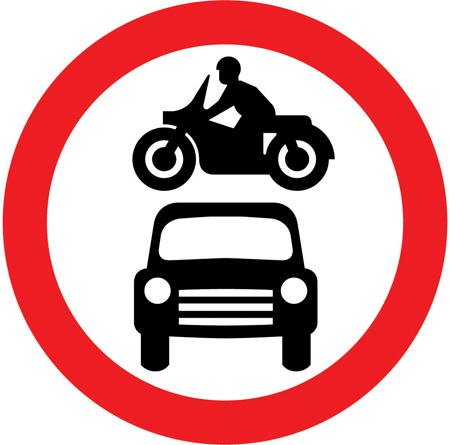
Learners famously misread this one as 'no motorcycles', 'motorcycles and cars only', or even as vehicles being allowed. The rule that untangles it: anything shown inside a red ring is what is banned. The motorcycle and the car together stand for motor vehicles in general — so this sign prohibits them all. You will often see it where a road is open to cyclists and pedestrians but closed to motor traffic.
Memory hook: red ring means banned. Bike and car inside means every motor vehicle is out.
4. National speed limits apply
National speed limits apply
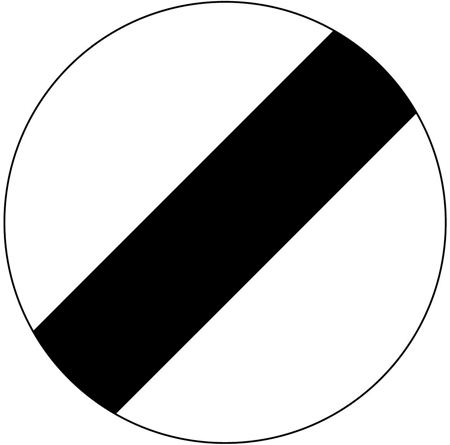
The most persistent myth in theory preparation: that this sign means 'no speed limit'. It never does. It means the national speed limit for your road type and vehicle now applies — for a car, that is 60 mph on a single carriageway and 70 mph on dual carriageways and motorways. It is also worth telling apart from the similar-looking end-of-restriction sign, which cancels a restriction shown by an earlier sign rather than setting a speed rule.
Memory hook: the diagonal means national, never no limit — 60 single, 70 dual and motorway for cars.
5. No stopping vs no waiting
No stopping
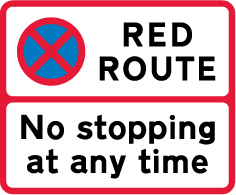
Two blue circles, one crucial difference. The red cross means no stopping — where this clearway restriction applies, you must not stop on the carriageway at all, even to drop someone off. The single red diagonal means no waiting: you may stop briefly, for example to let a passenger out, but you must not park and wait.
No waiting during the period shown
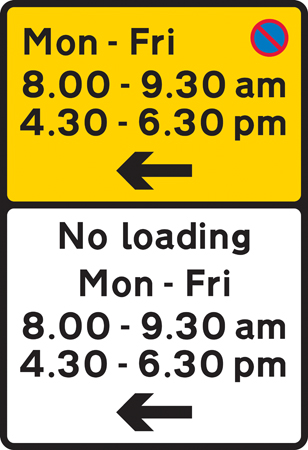
Notice the panel under the no-waiting example above: many waiting restrictions only apply during the times shown on the plate, so always read the panel as part of the sign. A cross has no such mercy — where a no-stopping clearway applies, it applies to stopping itself.
Memory hook: two lines, twice as strict. A cross means you can't even stop; one slash means you can't wait.
6. No overtaking
No overtaking
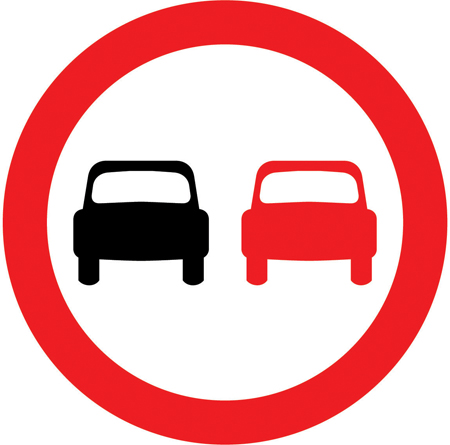
Learners sometimes read this as a warning about narrow roads or two-way traffic. Look closer: it is a red ring — an order, not a warning — and the red car is the one moving out of line to pass. You will meet it before bends, brows, and stretches where overtaking would be dangerous.
Memory hook: the red car is stepping out of line — don't be the red car.
7. The priority arrow pair
Priority must be given to vehicles from the opposite direction
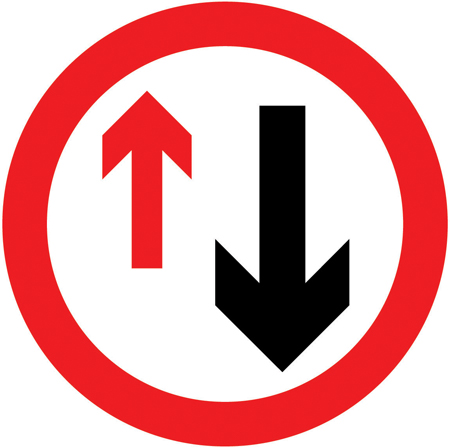
Priority must be given to vehicles from the opposite direction, explained
Traffic has priority over vehicles from the opposite direction
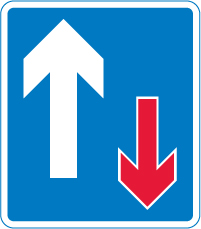
Traffic has priority over vehicles from the opposite direction, explained
These two appear at narrow sections where only one direction can pass at a time, and they are a classic exam pair because learners forget which arrow is theirs. Use the colours, not guesswork. The red-ring circle is an order aimed at you: give priority to oncoming traffic. The blue rectangle is information in your favour: your direction has priority. In both designs, the red arrow marks the direction that must give priority.
Memory hook: the red arrow shows the direction that must give priority.
8. Two-way traffic — ahead, or crossing?
Two-way traffic
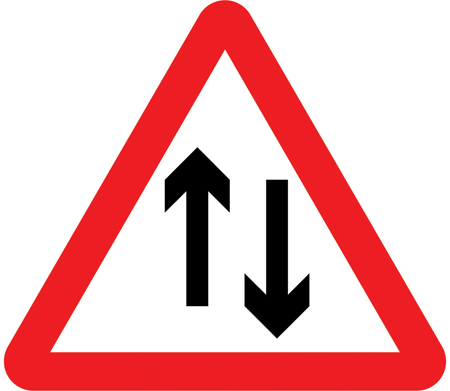
Two-way traffic on route crossing ahead
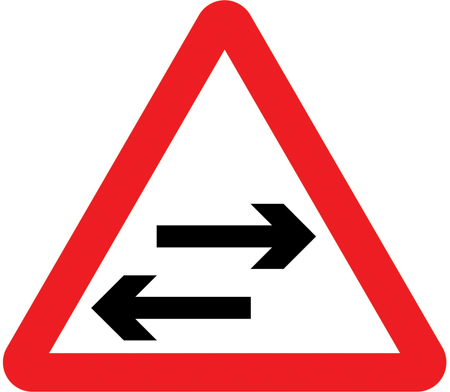
Two nearly identical warning triangles, and the entire difference is which way the arrows point. Take these slowly, because this is exactly the kind of detail multiple-choice questions test. Arrows running up and down mean the road you are on becomes two-way ahead — common when a one-way section or dual carriageway ends. Arrows running side to side mean a two-way road crosses yours ahead — so expect traffic passing across your path.
Memory hook: the arrows show the flow. Up-and-down is your road ahead; side-to-side is a road crossing yours.
9. Zebra crossing ahead vs pedestrians in road ahead
Zebra crossing ahead
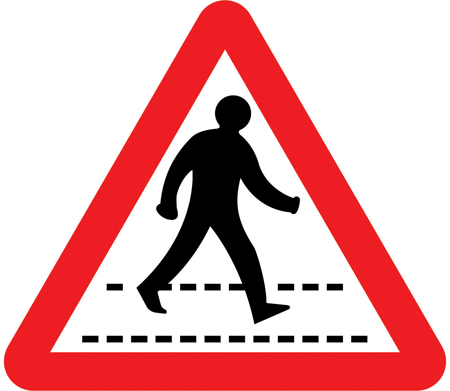
Pedestrians in road ahead
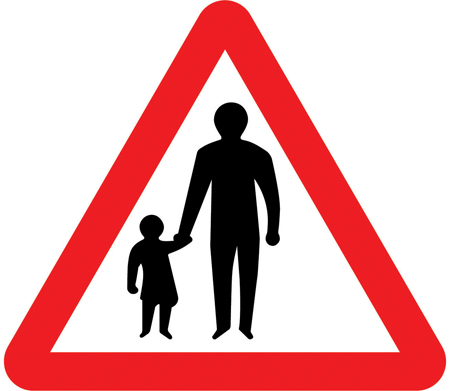
Both triangles show a walking figure, and learners routinely answer 'pedestrian crossing' for both. The detail that decides it is under the figure's feet. Stripes mean a zebra crossing is ahead — be ready to give way. No stripes means people may be walking in the road itself, typically on rural roads without a pavement, so slow down and give them room.
Memory hook: stripes under their feet mean a proper crossing; no stripes means people in the road itself.
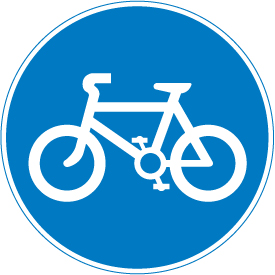
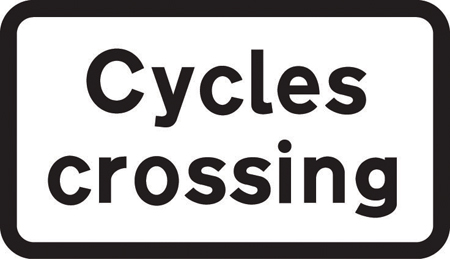
10. Three cycle signs, three different shapes
Route for use by pedal cycles only
Cycles crossing ahead
Riding of pedal cycles prohibited
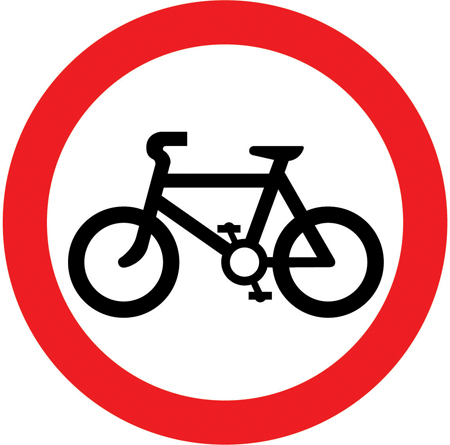
Same bicycle, three completely different meanings — and the picture tells you none of them. The shape does. The blue circle gives a positive instruction: this route is for cycles only. The triangle warns you: expect cyclists crossing or joining ahead. The red ring prohibits: no cycling here. If you learn to read shape first and symbol second, whole families of signs unlock at once.
Memory hook: same bike, three shapes. Blue circle instructs, triangle warns, red ring bans — the shape is the sentence.
How to actually make these stick
-
Practise recognition, not re-reading
Seeing a sign and recalling its meaning under light time pressure builds the skill the theory test measures. Re-reading a list does not.
-
Practise the confusable pairs together
Mixing no-stopping with no-waiting, or the two priority arrows, in the same session forces your brain to find the difference.
-
Short sessions, repeated
Ten minutes of sign practice several times a week beats one long cram. Come back to the signs you miss until they stop being misses.
-
Say the shape rule out loud
Triangle warns, red ring bans, blue circle instructs. If you can classify the shape, you can usually eliminate two wrong answers instantly.
Frequently asked questions
Which road signs do learners most commonly confuse?
From instructor experience, common mix-ups include no entry versus the plain red ring (which means no vehicles except bicycles being pushed), the national speed limit sign being misread as 'no limit', no stopping versus no waiting, the two priority arrow signs, the two two-way traffic triangles, and the zebra crossing versus pedestrians-in-road warnings.
Does the national speed limit sign mean there is no speed limit?
No. The white circle with a black diagonal stripe means national speed limits apply for your road type and vehicle — for a car, 60 mph on single carriageways and 70 mph on dual carriageways and motorways.
What is the difference between no stopping and no waiting signs?
The blue circle with a red cross means no stopping where the clearway restriction applies — you must not stop on the carriageway at all. The blue circle with a single red diagonal means no waiting — brief stops such as setting down a passenger are allowed, but you must not wait. Time panels under a sign limit when the restriction applies.
What is the best way to learn UK road signs?
Short, repeated recognition practice works better than re-reading sign lists. Practise similar-looking signs together, learn the shape system — triangles warn, red rings prohibit, blue circles instruct — and keep returning to the signs you get wrong until they stick.
Related learning
Part of a topic guide
Road signs for learner drivers
Part of Driving Mastery's road-signs guide helping UK learner drivers recognise, understand, and practise the signs that matter for theory preparation and real driving.
Road sign shapes and colours explained: the system behind UK signs
UK road signs follow a simple design system. Learn what triangles, circles, and rectangles mean, what the colours do, and the famous exceptions.
Warning road signs explained: junctions, bends, narrowing roads and hazards
Learn how UK warning signs work, including junction warnings, bends, narrowing roads, steep hills, pedestrian warnings and animal signs.
Regulatory road signs explained: red circles, blue circles, STOP and give way
Understand UK regulatory road signs: prohibitions, mandatory instructions, STOP, give way, turn bans, no entry and priority signs.
UK speed limit signs explained: national, minimum, and camera zones
A clear guide to UK speed limit signs — maximum limits, the national speed limit sign, minimum speed signs, and speed camera zones — with memory hooks and free practice.
Level crossing signs and signals explained
A clear guide to UK level crossing signs — gated and non-gated crossings, warning lights, and the stop-and-telephone signs learners often misread.
Test yourself on these signs free
Driving Mastery's road-signs practice covers the signs in this article and tracks which ones you keep missing, so revision targets the right gaps.
Practise road signs freeUnderstand sign shapes and colours
Once you can read shape and colour, unfamiliar signs stop being guesswork. Start with the companion guide to the design system behind UK signs.
Read the shapes guideDriving Mastery's learner guidance is written and reviewed by Niall Cullen, a UK approved driving instructor, so it stays practical, safe, and grounded in real driving lessons.