 Driving Mastery
Road signs
Level crossing signs and signals explained
A clear guide to UK level crossing signs — gated and non-gated crossings, warning lights, and the stop-and-telephone signs learners often misread.
Practise road signsQuick answer
- Level crossing signs look similar but mark different situations: gated, non-gated, or light-controlled crossings.
- A concealed level crossing is hidden by a bend or dip, so red-barred countdown markers may be used on the approach as well as the warning triangle — the bars count you down, they do not measure distance.
- A red warning triangle means a crossing is ahead; a rectangular sign at the crossing itself gives location or instruction detail.
- Some crossings have no barrier at all and rely entirely on you stopping if the lights show.
- A small number of signs instruct certain vehicles to stop and telephone before crossing — these are not optional.
Level crossing signs come up regularly in theory questions and cause genuine confusion, because several similar-looking signs describe quite different situations. This guide separates them by what actually happens at each type of crossing.
Concealed level crossings and countdown markers
First countdown marker on the approach to a concealed level crossing
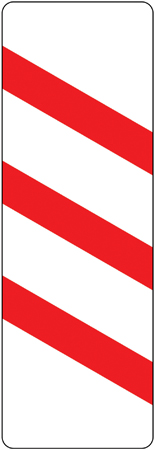
Final countdown marker before a concealed level crossing

A concealed level crossing is one you cannot see until you are close to it, because a bend, dip, or other obstruction hides the crossing, so you cannot yet spot a barrier, lights, or queuing traffic. The Highway Code's traffic signs guidance says white-backed markers with red bars may be used on the approach to one, in the same style as the countdown markers at a motorway exit. Know Your Traffic Signs gives the spacing: they divide the distance between the advance warning sign and the stop line into three equal parts. Do not read the bars as a distance. Each bar means 100 yards at a motorway exit, but the Highway Code says that here they do not represent 100 yard intervals — the Traffic Signs Manual notes the warning sign is usually less than 300 yards from the crossing. Treat them as "closer, closer, now" rather than a measurement.
Treat a concealed level crossing countdown marker as an instruction to slow down and be ready to stop, even though you cannot yet see what is ahead. By the time the crossing itself comes into view, a barrier may already be down or traffic may already be queuing.
Crossings with a gate or barrier
Level crossing with gate or barrier ahead
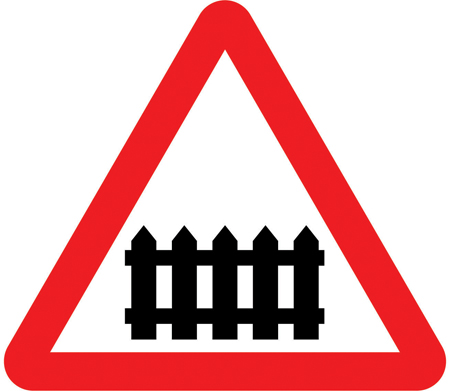
This is the most reassuring type: a physical gate or barrier lowers across the road when a train is coming, giving a clear, visible signal alongside any lights. The warning triangle simply tells you one is coming up, so you can start looking for the crossing itself.
Crossings without a gate or barrier
Railway level crossing without gate or barrier ahead
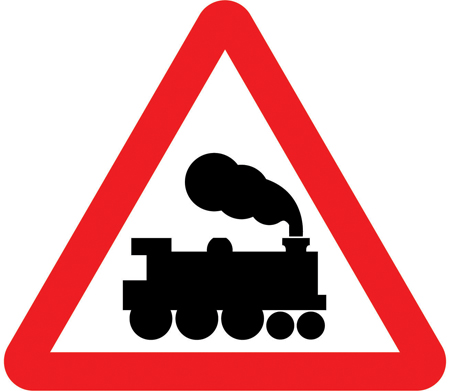
Railway level crossing without gate or barrier ahead, explained
Location of a level crossing without a gate or barrier

Location of railway or tramway level crossing without a gate or barrier, explained
Open railway level crossing without light signals
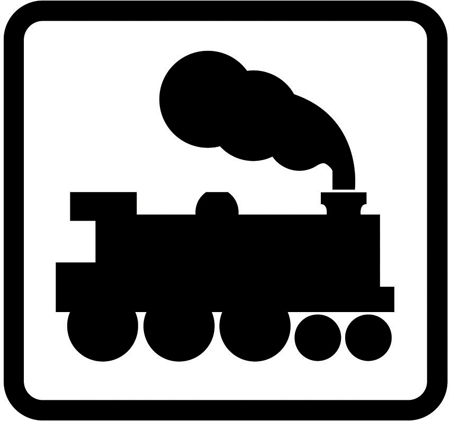
Open railway level crossing without light signals, explained
These are the crossings that catch learners out, because there is less machinery doing the work for you. Without a barrier, red light signals are usually the only automatic warning. At the rarer open crossings with no lights at all, GOV.UK describes the assembly as a give way sign over a symbol of a railway locomotive — so what you are giving way to is the train, not other road traffic, which is the part that catches people out. Highway Code rule 298 gives the advice that goes with it: you should look both ways, listen and make sure there is no train coming before you cross.
Memory hook: no barrier means the lights are doing the work instead — no lights means you are.
Light signals at level crossings
Advance warning of light signals at a level crossing
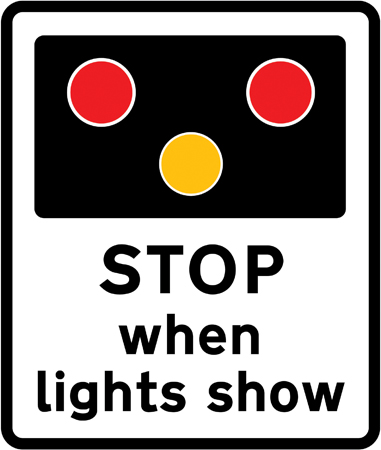
Advance warning of light signals at a level crossing with or without a gate or barrier, explained
Read this one carefully, because it is easy to get backwards. It does not tell you whether the crossing has a barrier — GOV.UK's guidance is explicit that it gives advance warning of light signals at a level crossing with or without a gate or barrier. What it tells you is that lights control the crossing, and lights are the thing you obey: stop when they show, whether or not a barrier follows them down. Assuming no barrier because you saw this plate is the mistake to avoid.
Signs for large or slow vehicles
Drivers of large or slow vehicles must stop and telephone before using an automatic crossing
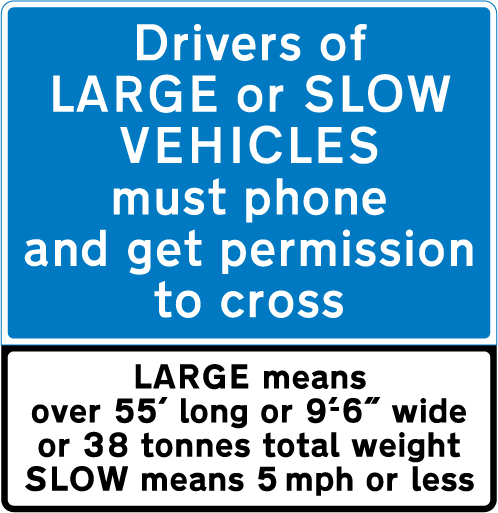
This sign only applies to drivers of large or slow vehicles, but it is worth every learner recognising it: it is a genuine instruction to stop and telephone the signal operator before using the crossing, because such vehicles may not clear it in time between a train's approach and arrival. Highway Code rule 294 carries a second duty that is easy to miss — you MUST also telephone when clear of the crossing if you are asked to do so.
What must not happen at a level crossing
Keep crossing clear
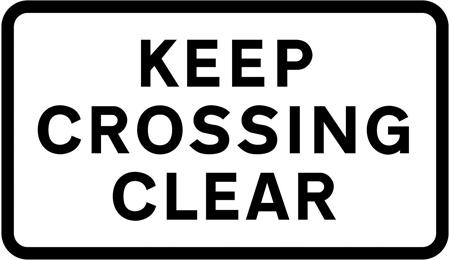
This rounds off the set with the habit that applies at every crossing: never let the car come to rest on it. Highway Code rule 291 puts it plainly — never stop or park on, or near, a crossing. Where yellow box markings are painted across the crossing, GOV.UK's guidance is about what you do before you move, not about braking once you are on it: do not enter the box if other stationary traffic may cause you to stop with any part of your vehicle inside it. Both come to the same thing in practice. If the traffic ahead means you cannot clear the crossing completely, wait before it rather than queuing onto it.
Memory hook: gate, lights, or nothing — the one rule that never changes is never stop on the crossing itself.
Frequently asked questions
What is a concealed level crossing?
A level crossing hidden by a bend or dip, so you cannot see it until you are close. As well as the usual warning triangle, white-backed countdown markers with red bars may be used on the approach; Know Your Traffic Signs says they split the distance from the advance warning sign to the stop line into three equal parts. The bars are a countdown, not a distance — the Highway Code says they do not represent 100 yard intervals. Slow down and be ready to stop before the crossing comes into view.
What is the difference between a gated and non-gated level crossing?
A gated crossing lowers a physical barrier across the road when a train approaches, alongside any lights. A non-gated crossing has no barrier, so you rely on light signals. At the rarest open crossings, with no lights either, a Give Way sign above a locomotive plate governs the crossing, and Highway Code rule 298 advises that you should look both ways, listen and make sure there is no train coming before you cross.
Can you stop on a level crossing if traffic is queuing?
No. Highway Code rule 291 says never stop or park on, or near, a crossing. Where yellow box markings are painted across it, the guidance is not to enter the box if other stationary traffic may cause you to stop with any part of your vehicle inside it. Either way the answer is the same: if traffic ahead means you cannot clear the crossing completely, wait before it rather than queuing onto it.
Do all vehicles have to stop and telephone before using a level crossing?
No, only drivers of large or slow vehicles at crossings marked with that specific instruction. It exists because such vehicles may not clear the crossing in time between a train's approach and arrival.
Related learning
Part of a topic guide
Road signs for learner drivers
Part of Driving Mastery's road-signs guide helping UK learner drivers recognise, understand, and practise the signs that matter for theory preparation and real driving.
Top 10 UK road signs learners get wrong (and how to remember them)
Ten road signs UK learners often mix up, why each one causes confusion, and simple memory hooks to keep them straight before your theory test.
Road sign shapes and colours explained: the system behind UK signs
UK road signs follow a simple design system. Learn what triangles, circles, and rectangles mean, what the colours do, and the famous exceptions.
Warning road signs explained: junctions, bends, narrowing roads and hazards
Learn how UK warning signs work, including junction warnings, bends, narrowing roads, steep hills, pedestrian warnings and animal signs.
Regulatory road signs explained: red circles, blue circles, STOP and give way
Understand UK regulatory road signs: prohibitions, mandatory instructions, STOP, give way, turn bans, no entry and priority signs.
UK speed limit signs explained: national, minimum, and camera zones
A clear guide to UK speed limit signs — maximum limits, the national speed limit sign, minimum speed signs, and speed camera zones — with memory hooks and free practice.
Practise level crossing signs free
Test how quickly you can tell gated, non-gated, and light-controlled level crossing signs apart.
Practise road signs freeTry a mock test with sign questions
Driving Mastery's mock tests include an image-based question on gated level crossings, covered in this guide.
Start a mock testDriving Mastery's learner guidance is written and reviewed by Niall Cullen, a UK approved driving instructor, so it stays practical, safe, and grounded in real driving lessons.