 Driving Mastery
Road signs
Warning road signs explained: junctions, bends, narrowing roads and hazards
Learn how UK warning signs work, including junction warnings, bends, narrowing roads, steep hills, pedestrian warnings and animal signs.
Practise road signsQuick answer
- Most UK warning signs are red-bordered triangles.
- A warning sign tells you what to expect ahead; it is not usually the order itself.
- Junction warning signs show the road layout, and the broader line shows the priority route.
- Plates under warning signs can add distance, direction, time, or the length of the hazard.
Warning signs are not there to decorate the road. They give you time to plan before the hazard arrives: reduce speed, check mirrors, adjust position, and be ready for another road user to appear. For theory test revision, the trick is to learn the families of warning signs rather than memorise every triangle separately.
The warning-sign rule: red triangle means look ahead
Crossroads ahead
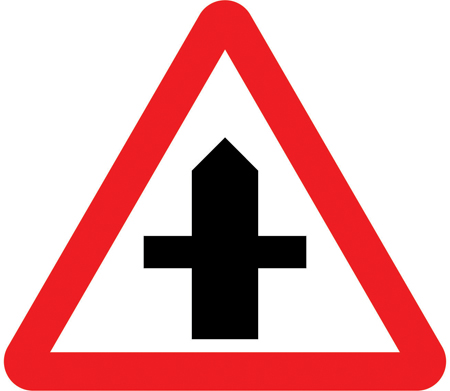
A red-bordered triangle usually warns you about something ahead: a junction, bend, narrowing road, steep hill, pedestrian area, animal hazard, or another danger. It does not normally tell you to stop by itself. Instead, it tells you to prepare for the road situation that is coming.
Junction warning signs
Staggered junction ahead
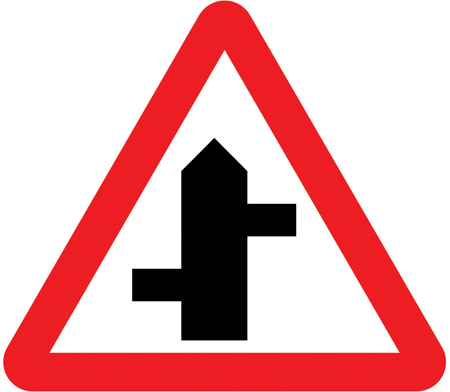
Junction warning signs are diagrams. Crossroads, T-junctions, side roads, staggered junctions, and traffic-merging signs all ask the same question: where could traffic appear from? The official guidance notes that the broader line on junction signs shows the priority route, which helps you read what the major road is doing.
Learner memory hook: do not name the picture first. Trace the traffic. Ask where another vehicle could enter, cross, merge, or turn across your path.
Bends and road layout warnings
Double bend ahead
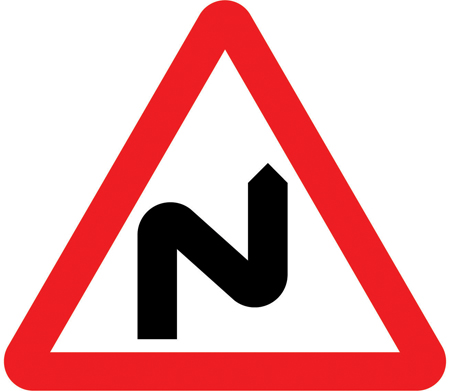
Double bend or series of bends ahead, first to the right, explained
Bend signs matter because your view may shorten before the hazard is visible. A single bend, double bend, adverse camber, junction on a bend, or sharp deviation sign should make you plan early: mirrors, speed, gear, position, and space. If there is a plate underneath, read it as part of the warning.
Road narrows on both sides ahead
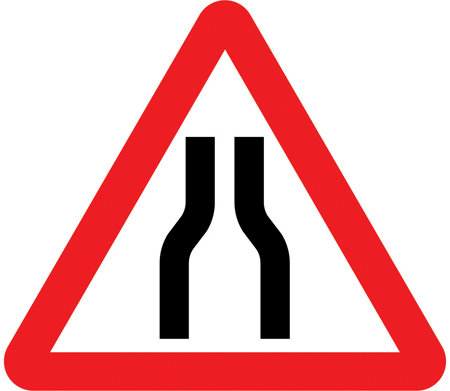
Road-narrows signs are easy to skim past in revision, but they matter in real driving. Narrowing on the left, right, or both sides changes where you position and whether another vehicle may need extra room.
Surface, hill and water hazards
Slippery road ahead
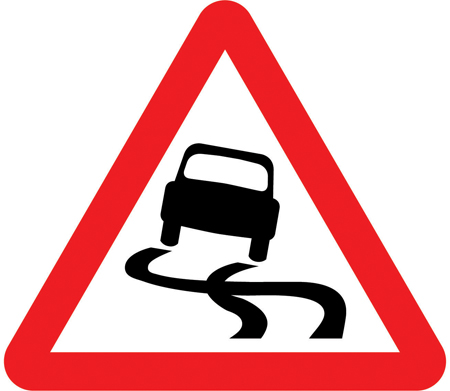
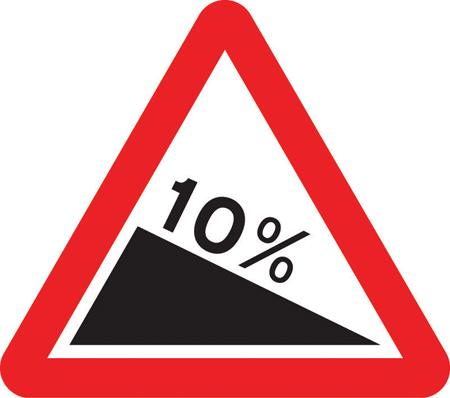
Slippery road, steep hill, ford, hump bridge, uneven road, and side-wind signs all point to the same driving skill: build more margin before the hazard. Slow earlier, avoid harsh steering or braking, and be ready for other road users to react unpredictably.
Steep hill downwards ahead
Pedestrian, school and animal warnings
Children going to or from school
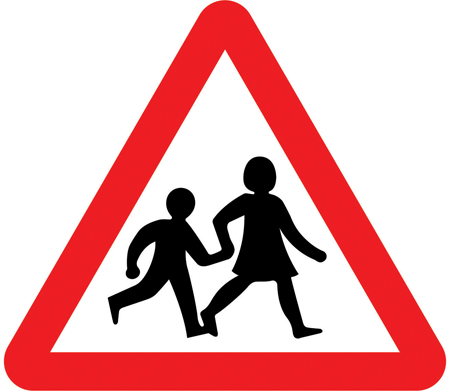
Children going to or from school or playground ahead, explained
Pedestrian, school, cycle, horse, wild animal, sheep, cattle and agricultural-vehicle signs are different pictures with the same message: look for vulnerable or slower road users before you reach them. In the theory test, pay attention to the exact figure and any plate below it.
How to answer warning-sign questions
-
Start with the shape
A red triangle means warning. The answer should normally describe what to expect, not an instruction like 'must turn'.
-
Read the diagram
For junction signs, trace the road lines. For bend signs, follow the direction of the curve. For narrowing signs, check which side loses space.
-
Check the plate
A plate may add distance, direction, time, or the length of the hazard. Do not ignore it in a question.
-
Think like a driver
Ask what you would change: speed, position, mirrors, following distance, or readiness to give way.
Frequently asked questions
What shape are most UK warning signs?
Most UK warning signs are red-bordered triangles. They warn you about something ahead, such as a junction, bend, narrowing road, pedestrian area, animal hazard, or road-surface problem.
Do warning signs give orders?
Usually no. A warning sign tells you what to expect ahead so you can plan safely. Orders are normally shown by circular regulatory signs, such as red-ring prohibition signs or blue mandatory instruction signs.
What do plates under warning signs mean?
Plates add detail to the warning, such as how far away the hazard is, which direction it is in, when it applies, or how long the hazard continues.
Related learning
Part of a topic guide
Road signs for learner drivers
Part of Driving Mastery's road-signs guide helping UK learner drivers recognise, understand, and practise the signs that matter for theory preparation and real driving.
Top 10 UK road signs learners get wrong (and how to remember them)
Ten road signs UK learners often mix up, why each one causes confusion, and simple memory hooks to keep them straight before your theory test.
Road sign shapes and colours explained: the system behind UK signs
UK road signs follow a simple design system. Learn what triangles, circles, and rectangles mean, what the colours do, and the famous exceptions.
Regulatory road signs explained: red circles, blue circles, STOP and give way
Understand UK regulatory road signs: prohibitions, mandatory instructions, STOP, give way, turn bans, no entry and priority signs.
UK speed limit signs explained: national, minimum, and camera zones
A clear guide to UK speed limit signs — maximum limits, the national speed limit sign, minimum speed signs, and speed camera zones — with memory hooks and free practice.
Level crossing signs and signals explained
A clear guide to UK level crossing signs — gated and non-gated crossings, warning lights, and the stop-and-telephone signs learners often misread.
Test yourself on warning signs
Use short recognition practice to build speed with junction signs, bend signs, narrowing roads, and vulnerable-road-user warnings.
Practise road signs freeLearn signs that give orders
Once warning triangles make sense, move to regulatory signs: red circles, blue circles, STOP, give way, and turn bans.
Read regulatory signsDriving Mastery's learner guidance is written and reviewed by Niall Cullen, a UK approved driving instructor, so it stays practical, safe, and grounded in real driving lessons.