 Driving Mastery
Revision strategy
How to pass your theory test in 3 days
A realistic 3-day theory test revision plan for learners who have already booked: find the weak topics first, fix those, and leave hazard perception time.
Try 25 free practice questionsQuick answer
- Three days is enough to fix gaps, but not enough to learn the whole syllabus from scratch.
- Spend day one finding your weak topics instead of reading from the beginning.
- You need 43 out of 50 for multiple choice and 44 out of 75 for hazard perception, so both halves need time.
- Changing the date free of charge needs 3 full working days' notice, so with three days left that window has probably closed.
Most people asking this have already booked. The test is on Thursday, it is Monday now, and the real question is whether three days is enough. The honest answer depends almost entirely on where you are starting from, and you can find that out in about half an hour.
Three days is enough time to close gaps. It is not enough time to learn every topic from nothing. If you have had driving lessons, read parts of the Highway Code, or answered practice questions before, you are in the first group. If you have done none of those things, read the section on moving the test before you spend three evenings on this.
Day 1: find out where you actually stand
The instinct on a short deadline is to start at the beginning and read forwards. That is the worst possible use of three days, because most of what you read will be material you already know, and you will run out of time before you reach the parts you do not.
Do the opposite. On a longer run-up this would be the wrong order, and our four-week plan says so: learn the topics first, because a cold score mostly tells you that you have not studied yet. Three days does not allow that. Test first, and treat the score as a map rather than a verdict. A low score on day one is useful. A low score on day three is a problem.
The categories matter more than the score
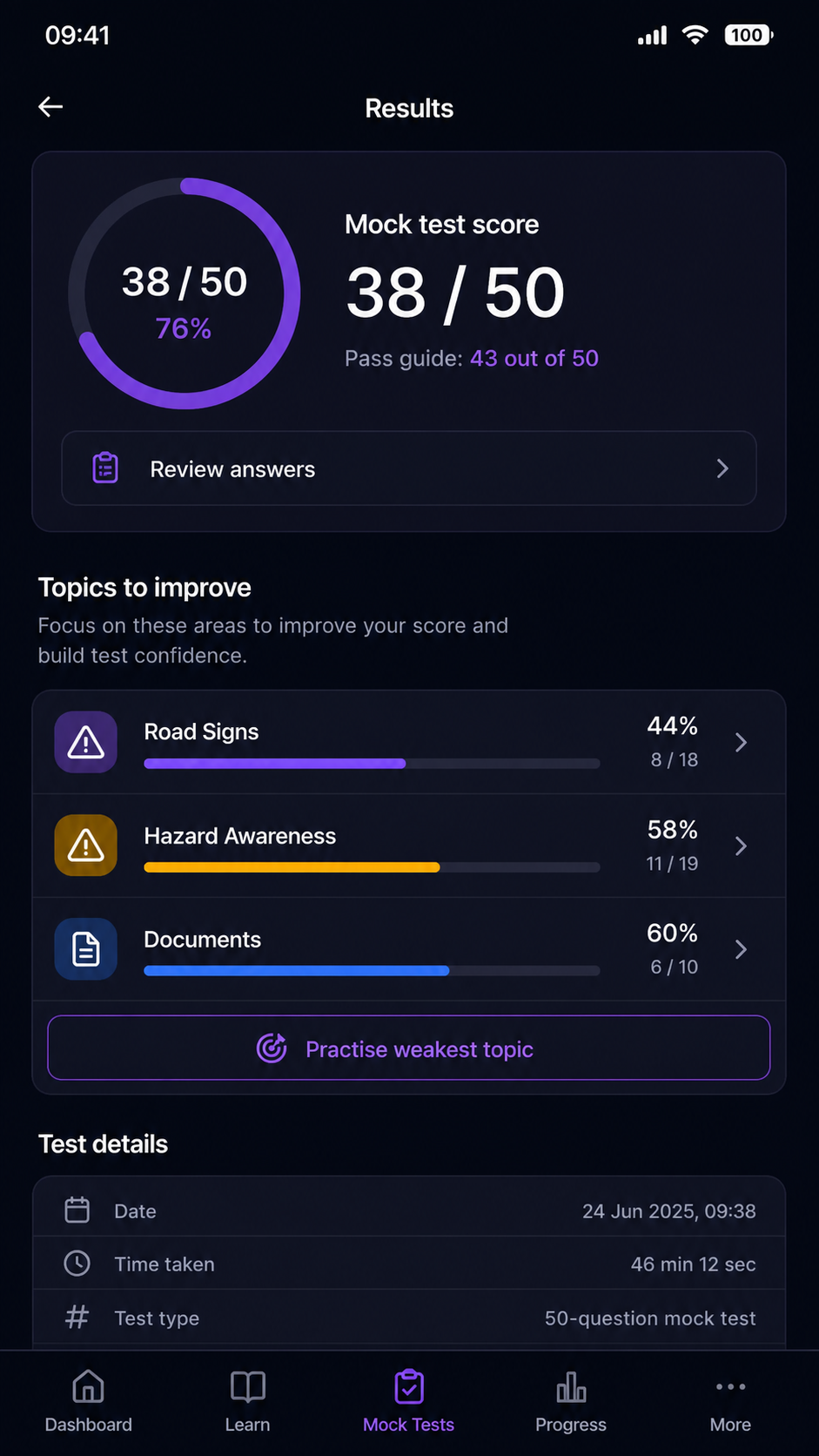
-
Test yourself cold
Do not revise first. On a three-day deadline an unprepared score is the fastest way to see which topics are actually weak.
-
Write down categories, not questions
Record the topics you got wrong, such as road signs or safety margins. Individual questions will not reappear word for word; the topics will.
-
Rank them by how many marks they cost
A topic that cost you six marks matters more this week than one that cost you one, however uncomfortable it feels.
-
Leave your strong topics alone
Revising what you already know is the most common way to waste a short deadline. It feels productive because the answers are right.
Day 2: fix the weak topics, not all of them
Take the top three or four categories from day one and work through them properly. That means learning the rule, not memorising the answer, because the wording on the day will not match the wording you practised.
Road signs are worth separating out even if they did not appear in your worst three. Recognising a sign is recall rather than reasoning, which makes signs one of the few topics you can genuinely improve in a couple of short sessions.
- Work on one topic at a time until the answers stop surprising you.
- After each wrong answer, write the rule in your own words before moving on.
- Retest the same topic later the same day, not immediately afterwards.
- Give road signs a separate session, because recognition needs to be fast rather than reasoned.
Do not leave hazard perception until the end
Hazard perception is scored separately, and the pass mark for that half is 44 out of 75. You can answer the questions well and still fail the whole theory test on the clips, which is exactly what happens to learners who spend three days on multiple choice alone.
It also behaves differently from revision. You are not recalling a fact, you are learning when to click, and that improves with repetition rather than reading. You do not lose points for clicking and getting it wrong, but GOV.UK is explicit that you will not score anything if you click continuously or in a pattern, so more clicks is not a tactic. Even a short session on each of the three days beats one long session the night before.
Day 3: test under real conditions
The last day is for checking whether the fixes held, not for learning anything new. Starting a fresh topic the night before a test tends to unsettle what you already know rather than add to it.
-
Retest the topics you fixed
Focused questions on yesterday's weak areas, to check the improvement is real and not just familiarity.
-
Sit one timed run in one go
Timed, phone away, no pausing. The real test gives you 57 minutes for 50 questions, so a full-length mock is the closest rehearsal and needs an account. Without one, take the longest run available to you and still put a clock on it.
-
Review only the mistakes
Go through what you got wrong, then stop. Re-reading correct answers adds nothing at this point.
-
Read the margin, not just the pass
A single score of 43 is a pass on paper, not a margin. With more time you would want repeated scores in the high 40s before booking, so treat a narrow pass as a sign that one unfamiliar question could decide the test.
-
Sleep rather than cram
A tired reader misreads questions, and a misread question costs the same mark as one you never knew.
Should you move the test instead?
This is the part most three-day guides leave out, and the timing rule catches people out. To change a theory test without paying again you need to give at least 3 full working days' notice. Monday to Saturday count as working days; Sundays and public holidays do not.
Counted back, that deadline lands earlier than it sounds. For a test on Thursday, notice had to be given by the previous Saturday. So if you are reading this with three days to go, the free window has almost certainly closed already.
That changes the decision rather than removing it. Once the free window has passed, moving the test costs the same fee as failing it would, so there is no longer a money argument for moving. If you can no longer move the test without paying again, sit it. You might pass, and if you do not, you will know exactly what the real thing is like before you book again.
There is one exception worth knowing about. If you cannot sit the test because of illness or injury, a bereavement, an exam at a school or college, or a stolen driving licence, GOV.UK may still refund a short-notice cancellation, though you have to send evidence such as a fit note or a crime number. Not feeling ready is not on that list.
Moving is the better call whenever you can still do it for free, which in practice means deciding about a week ahead rather than three days ahead. If your test is further away than this article assumes and any of the following is true, change the date now while it costs nothing.
- You have not yet opened the Highway Code or answered a practice question.
- Your first mock test score is a long way below the pass mark rather than just under it.
- Work, illness, or family means the days you planned to revise are not actually free.
- You have not practised hazard perception at all, which is half the test.
One thing worth checking now
Learners do turn up without the right documents and lose the fee without sitting the test, which is a painful way to end three days of revision. Check what you need to bring while you still have time to do something about it.
Frequently asked questions
Can you pass the theory test in 3 days?
It is possible if you already have some knowledge from lessons, the Highway Code, or earlier practice, because three days is enough time to close gaps. It is much harder if you are starting from nothing, since the test covers a wide syllabus and hazard perception is scored separately.
How many hours a day should I revise?
Two to three focused hours a day is more useful than one long cramming session. Split it into shorter blocks, and include some hazard perception practice each day rather than saving it for the end.
Should I just memorise the answers in 3 days?
No. Questions are worded differently on the day, so memorised answers often do not match what you are asked. Learning the rule behind an answer takes slightly longer and holds up far better under test conditions.
Should I move my theory test if I am not ready?
Only if you can still do it free. Changing a theory test without paying again needs at least 3 full working days' notice, and while Monday to Saturday count as working days, Sundays and public holidays do not. For a Thursday test that means giving notice by the previous Saturday. Once that window has passed, moving costs the same fee as failing would, so there is no money reason to move.
Related learning
When you are ready to revise
Theory Access — £5.99, one payment
Work through the question bank by category, see every question you got wrong and why, and sit timed mock tests in the real format. No subscription.
Not sure yet? The free 25-question diagnostic needs no account and shows you which categories are weakest.
See what Theory Access includesPart of a topic guide
Theory test strategy and readiness
Part of Driving Mastery's test strategy guide helping UK learner drivers plan revision, read their mock results, and judge when they are genuinely ready for test day.
How to pass the theory test first time: a realistic 4-week plan
A week-by-week theory test revision plan covering both parts of the test - the questions and hazard perception - so first-time scores are more consistent.
Failed a mock test? Good — here's how to use it
A failed mock test is more useful than a passed one if you read it properly. Learn how to turn a weak result into a focused revision plan.
Take a mock test before you revise
On a three-day deadline, an unprepared score is the fastest way to see which topics are actually weak, and it takes less than an hour.
Start a mock testGive hazard perception its own time
It has a separate pass mark, and it improves with repetition rather than reading.
How to practise hazard perceptionDriving Mastery's learner guidance is written and reviewed by Niall Cullen, a UK approved driving instructor, so it stays practical, safe, and grounded in real driving lessons.