 Driving Mastery
Test strategy
How to pass the theory test first time: a realistic 4-week plan
A week-by-week theory test revision plan covering both parts of the test - the questions and hazard perception - so first-time scores are more consistent.
Try 25 free practice questionsQuick answer
- Weeks 1-2: learn the theory topics one at a time, not full mock tests, and learn how hazard perception is scored.
- Week 3: start mixed mock tests to build stamina and timing, and start practising hazard perception clips.
- Week 4: retest your weakest categories, keep practising clips, and simulate test-day conditions.
- Hazard perception has its own pass mark, and you must pass both parts of the test.
- A single high mock score is less useful than several consistent ones above the pass mark.
There is no guaranteed way to pass the theory test, but there is a realistic pattern that gives you the best chance first time: learn the topics before you test yourself on them, then use mock tests to check what is actually sticking, rather than to teach you the material.
Four weeks is enough for most learners if the time is structured. The plan below assumes a few short sessions most days, not one long cram at the end.
Weeks 1-2: learn the topics, do not jump to mocks
The biggest mistake in early revision is doing full 50-question mock tests before you know the material. A low early score does not tell you much except that you have not studied yet, and it can knock confidence for no reason.
- Work through one theory category at a time, such as alertness, attitude, safety margins, or vulnerable road users.
- Answer focused questions on that category only, and review every mistake before moving on.
- Keep a short note of categories that took longer to understand, so you know where to return later.
- Treat road signs as their own study block; they reward repetition more than reasoning.
- Read how hazard perception is scored before you practise it: points come from responding as a developing hazard starts to develop, and GOV.UK says clicking continuously or in a pattern scores nothing.
Week 3: build mixed mock-test stamina
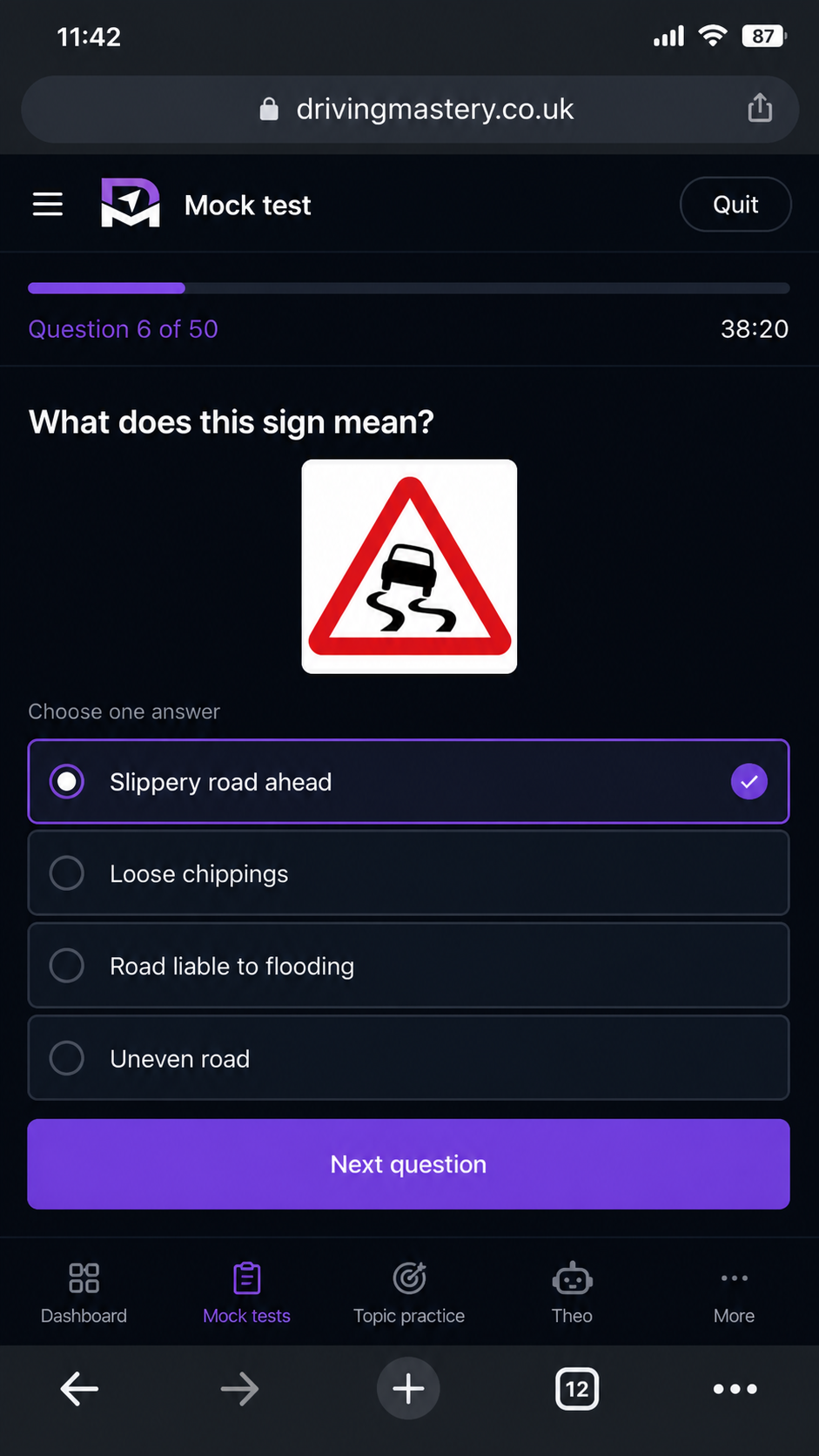
Once you have covered the main categories, switch to mixed mock tests. This is where you practise the skill the test actually demands: recognising which topic a question belongs to and answering it under time pressure, with categories arriving in no particular order.
Practise the full 50-question format once the topics are covered
-
Step 1
Take a full mock test at a normal pace, without pausing to look things up.
-
Step 2
Review every wrong answer by category, not just the final score.
-
Step 3
Spend a short focused session on whichever category produced the most mistakes.
-
Step 4
Repeat with a fresh mixed mock a day or two later, rather than immediately retaking the same one.
Weeks 3 and 4: practise hazard perception alongside the mocks
The theory test has two parts and you must pass both. The pass mark for the multiple-choice questions is 43 out of 50; for hazard perception you need 44 out of 75. If you fail either part, you book and take the whole test again - so a plan that only covers the questions can leave you passing one part and failing the other.
Hazard perception is a different skill from answering questions, and mock tests of the questions on their own will not train the timing it is scored on. Give it its own short sessions from week 3: watch clips, look at when you responded compared with when the hazard started to develop, and spend more time on the types of clip where you are consistently late.
Week 4: tighten weak topics and simulate test day
In the final week, stop introducing new material. Focus on the categories that are still costing marks, and take one or two full mock tests under test-like conditions: no notes, no pausing, timed properly. Keep a hazard perception session in the week too, so your clip practice is as recent as your question practice.
The multiple-choice pass mark is 43 out of 50, but that should not be your practice target. National pass rates have not been improving, so treat 43 as a floor, not a goal.
Common mistakes that slow this plan down
- Repeating the same mock test until you memorise the answers instead of the reasoning.
- Doing only full mocks and never returning to focused category practice.
- Cramming road signs the night before instead of little and often across all four weeks.
- Booking test day before your mock scores are consistently above the pass mark, not just once above it.
- Leaving hazard perception until the last few days. It has its own pass mark, and failing it means taking both parts again.
Frequently asked questions
Is 4 weeks enough time to revise for the theory test?
For most learners doing short sessions most days, 4 weeks is enough if the time is structured: topics first, then mixed mock tests and hazard perception practice, then focused revision of weak areas. Both parts of the test have their own pass mark, so the plan has to cover both.
When should I practise hazard perception in a 4-week plan?
Learn how it is scored in the first two weeks, then give it its own short sessions from week 3 alongside your mock tests, and keep practising in week 4. You must pass both parts of the theory test: 43 out of 50 on the questions and 44 out of 75 on hazard perception.
Should I do full mock tests from day one?
No. Learn the theory categories first so a mock test measures real knowledge rather than telling you that you have not studied yet.
What score should I be aiming for in practice, not just the pass mark?
The pass mark is 43 out of 50, but aim for repeated scores in the high 40s across several mock tests before booking.
How do I know if I am ready for test day?
Consistency matters more than one good score. If your mock-test results are comfortably and repeatedly above the pass mark across mixed categories, that is a stronger signal than a single high attempt.
Related learning
When you are ready to revise
Theory Access — £5.99, one payment
Work through the question bank by category, see every question you got wrong and why, and sit timed mock tests in the real format. No subscription.
Not sure yet? The free 25-question diagnostic needs no account and shows you which categories are weakest.
See what Theory Access includesPart of a topic guide
Theory test strategy and readiness
Part of Driving Mastery's test strategy guide helping UK learner drivers plan revision, read their mock results, and judge when they are genuinely ready for test day.
Failed a mock test? Good — here's how to use it
A failed mock test is more useful than a passed one if you read it properly. Learn how to turn a weak result into a focused revision plan.
How to pass your theory test in 3 days
A realistic 3-day theory test revision plan for learners who have already booked: find the weak topics first, fix those, and leave hazard perception time.
Learn the topics before testing yourself
Work through theory categories one at a time so mock tests in week 3 check real knowledge, not guesswork.
Study theory modulesPart of Theory Access, £5.99 one-time
Confirm you are consistently above the pass mark
Use a mock test to check whether your weakest categories are actually fixed before you book.
Start a mock testDriving Mastery's learner guidance is written and reviewed by Niall Cullen, a UK approved driving instructor, so it stays practical, safe, and grounded in real driving lessons.