 Driving Mastery
Test strategy
Failed a mock test? Good — here's how to use it
A failed mock test is more useful than a passed one if you read it properly. Learn how to turn a weak result into a focused revision plan.
Try 25 free practice questionsQuick answer
- A failed mock test shows you exactly what to revise before it matters.
- Read the result by category, not just the final score.
- Fix the weakest category with a short focused session, then retest a day or two later.
- Retesting the same mock immediately just tests your memory, not your knowledge.
A failed mock test feels discouraging, but it is doing exactly what it should: showing you a gap before test day, when there is still time to close it. A mock you pass without effort tells you far less.
The score is the least useful part of a failed result
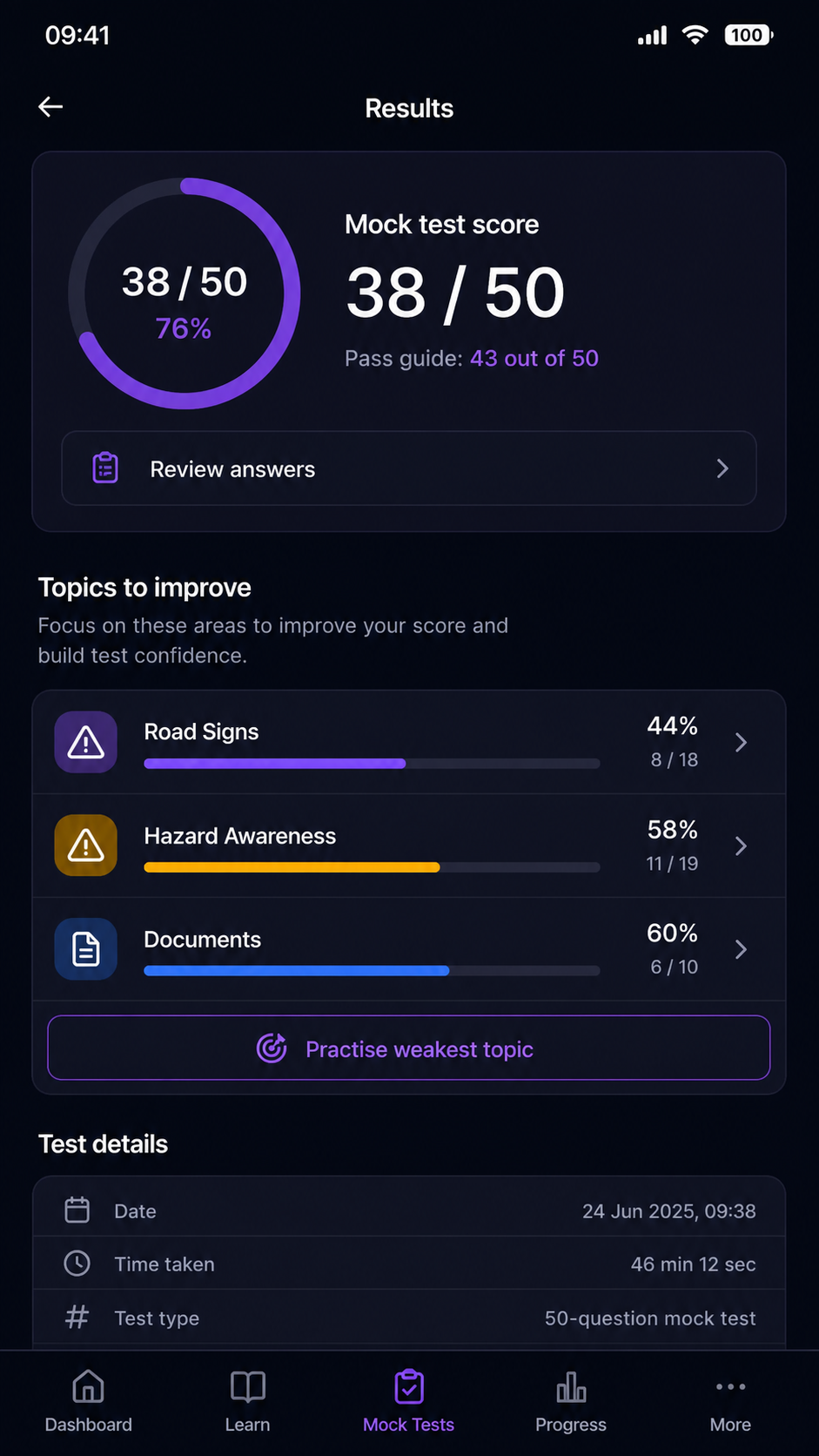
Why a failed mock is more useful than a passed one
A pass tells you that you cleared the bar on that particular set of questions. It does not tell you which topics you would still get wrong if the questions were different. A fail, read properly, points directly at the categories that need work while there is still time to fix them.
Read your result by category, not by score
- Look at which categories your wrong answers came from, not just the total.
- A scattered set of mistakes across many topics usually means more practice time overall is needed.
- A cluster of mistakes in one or two categories, such as road signs or documents, is a faster fix.
- Ignore any single unusual question that does not fit a pattern; it is not worth chasing.
Turn the weakest category into a short revision loop
-
Step 1
Pick the category with the most wrong answers, not the one that feels most familiar.
-
Step 2
Study that topic directly rather than repeating mixed questions.
-
Step 3
Answer focused questions on that category only, and check the reasoning behind each mistake.
-
Step 4
Return to a mixed mock a day or two later to see whether the category has genuinely improved.
A failed result should point to one clear next step
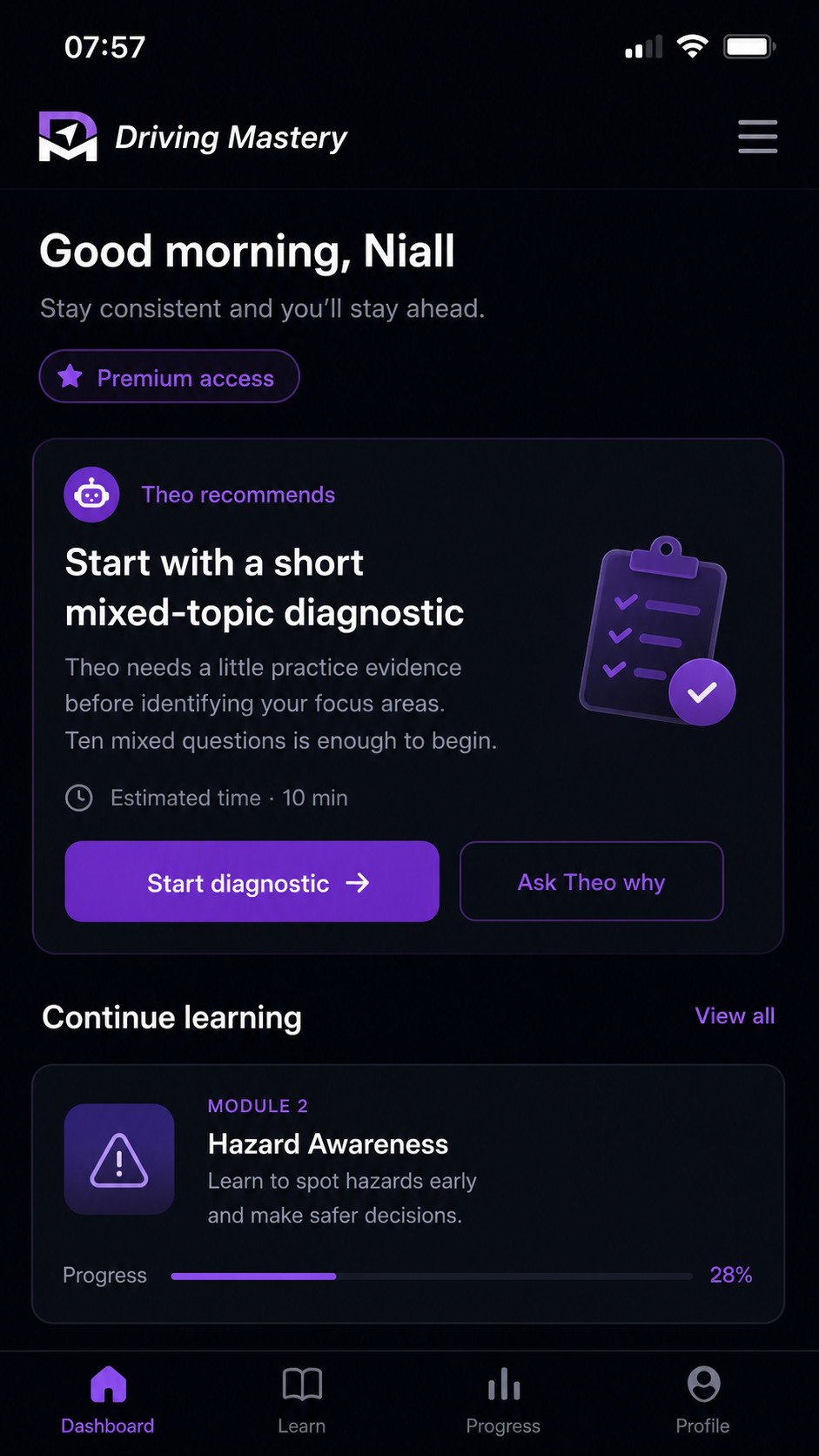
How often should you retest after a fail?
Retesting immediately, with the same questions still fresh in your head, mostly measures memory rather than knowledge. Leaving a day or two between a focused revision session and the next mock gives a more honest read on whether the category has actually improved.
When a failed mock means something different
If every mock test result looks scattered with no clear pattern, that usually means the underlying topics have not been learned yet, not that you had a bad day. In that case, step back to studying categories directly for a while before returning to full mixed mocks.
Frequently asked questions
Should I be worried if I fail a mock theory test?
No. A mock test is a practice tool. A fail is most useful when you use it to find and fix specific weak categories before test day.
Should I retake the same mock test straight after failing it?
Retesting immediately mostly checks memory rather than knowledge. It is more useful to revise the weak category first, then take a fresh mixed mock a day or two later.
How do I know which topics caused my failed score?
Review your wrong answers by category rather than looking at the final score alone. A mock test result that groups mistakes by topic makes this faster.
What if my mistakes are spread across many categories?
Scattered mistakes across many topics usually mean the underlying material needs more study time overall, rather than one quick fix.
Related learning
When you are ready to revise
Theory Access — £5.99, one payment
Work through the question bank by category, see every question you got wrong and why, and sit timed mock tests in the real format. No subscription.
Not sure yet? The free 25-question diagnostic needs no account and shows you which categories are weakest.
See what Theory Access includesPart of a topic guide
Theory test strategy and readiness
Part of Driving Mastery's test strategy guide helping UK learner drivers plan revision, read their mock results, and judge when they are genuinely ready for test day.
How to pass the theory test first time: a realistic 4-week plan
A week-by-week theory test revision plan covering both parts of the test - the questions and hazard perception - so first-time scores are more consistent.
How to pass your theory test in 3 days
A realistic 3-day theory test revision plan for learners who have already booked: find the weak topics first, fix those, and leave hazard perception time.
Find out which categories actually cost you marks
Use a short mock test to confirm the weak categories before you spend time revising the wrong topic.
Start a mock testConfirm the weak category is genuinely fixed
Return to a mixed mock test to see whether the category holds up once the questions are no longer fresh in memory.
Take a mock testDriving Mastery's learner guidance is written and reviewed by Niall Cullen, a UK approved driving instructor, so it stays practical, safe, and grounded in real driving lessons.