Vehicle Handling
What’s the purpose of the yellow lines painted across the road?

This product includes the Driver and Vehicle Standards Agency (DVSA) revision question bank.
Free mock test
Question 1 of 25
25 questions across theory topics. Create an account after results to save progress.
Vehicle Handling
These lines may be painted on the road on the approach to a roundabout, a village or a particular hazard. The lines are raised and painted yellow, and their purpose is to make you aware of your speed. Reduce your speed in good time so that you avoid having to brake harshly over the last few metres before reaching the junction.
Hazard Awareness
Hazard warning lights are an important safety feature. Use them when driving on a motorway or unrestricted dual carriageway to warn traffic behind you of danger ahead. You should also use them if your vehicle has broken down and is causing an obstruction.
Alertness

These lines are often found on the approach to a roundabout or a dangerous junction. They give you extra warning to adjust your speed. Look well ahead and do this in good time.
Rules of the road
Do not reverse into a main road from a side road because your view will be restricted. The main road is likely to be busy and the traffic on it moving quickly.
Motorway Rules
On a three-lane motorway, you should travel in the left-hand lane unless you’re overtaking. This applies regardless of the speed at which you’re travelling.
Documents
The vehicle you drive must be roadworthy and in good condition. If it's over 3 years old, it must pass an MOT test to remain in use on the road (unless it's exempt from the MOT test – see GOV.UK).
Incidents, Accidents, Emergencies
A broken-down vehicle in a tunnel can cause serious congestion and danger to other road users. If your vehicle breaks down, get help without delay. Switch on your hazard warning lights, then go to an emergency telephone to call for help.
Hazard Awareness
When you're towing a caravan and it begins to 'snake', you need to bring it back under control. Do not steer sharply or brake hard. Instead, you should ease off the accelerator and gradually reduce your speed until the caravan stops snaking.
Other Types of Vehicle
You should take extra care when you first encounter trams. You'll have to get used to dealing with a different traffic system. Be aware that trams can accelerate and travel very quickly, and they cannot change direction to avoid obstructions.
Safety And Your Vehicle
An engine can use more oil during long journeys than on shorter trips. Insufficient engine oil is potentially dangerous: it can lead to excessive wear, mechanical breakdown and expensive repairs. Most cars have a dipstick to allow the oil level to be checked. If not, you should refer to the vehicle handbook.
Safety Margins
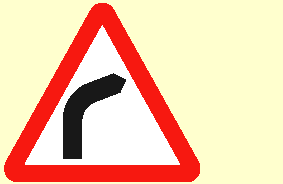
Keeping to the left as you approach right-hand bends will give you an earlier view around the bend and allow you to see any hazards sooner. It also reduces the risk of collision with any oncoming vehicle that may have drifted over the centre line while taking the bend.
Vulnerable Road Users
Pedestrians and riders on 2 wheels can be harder to see than other road users. Make sure you look for them, especially at junctions. Effective observation, coupled with appropriate action, can save lives.
Vehicle Loading
You need to know how to tow a trailer safely. This includes hitching the trailer to your vehicle, checking the trailer for defects, reversing with a trailer and how to deal with any problems. There are accredited trainers who can teach you these skills. Professional training will also give you confidence in your ability to tow a trailer safely.
Motorway Rules
You should drive in the left-hand lane whenever possible. Only use the other lanes for overtaking or when directed to do so by signals. Using other lanes when the left-hand lane is empty can frustrate drivers behind you.
Attitude
Pull over in a place where the ambulance can pass safely. Check that there are no bollards or obstructions in the road that will prevent it from passing.
Alertness
Except for emergencies, it’s illegal to use a hand-held mobile phone while you're driving. Even using a hands-free kit can severely distract your attention.
Other Types of Vehicle
In windy weather, watch out for motorcyclists and also cyclists, as they can be blown sideways into your path. When you pass them, leave plenty of room and check their position in your mirror before pulling back in.
Safety And Your Vehicle
Inconsiderate parking can obstruct the flow of traffic and so make traffic congestion worse. Red routes are designed to prevent this by enforcing strict parking restrictions. Driving slowly in traffic increases fuel consumption and causes a build-up of exhaust fumes.
Safety Margins
Coasting is the term used when the clutch is held down, or the gear lever is in neutral, and the vehicle is allowed to freewheel. This reduces the driver's control of the vehicle. When you coast, the engine cannot drive the wheels to stabilise you through a corner, or give the assistance of engine braking to help slow the car.
Vehicle Loading
Any load must be securely fastened to the vehicle. The safest way to carry items on the roof is in a specially designed roof box. This will help to keep your luggage secure and dry, and it also has less wind resistance than loads carried exposed on a roof rack.
Road and Traffic Signs

At junctions controlled by traffic lights, you must stop behind the white line until the lights change to green. A red light, an amber light, and red and amber lights showing together all mean stop. You may proceed when the light is green unless your exit road is blocked or pedestrians are crossing in front of you. If you’re approaching traffic lights that are visible from a distance and the light has been green for some time, be ready to slow down and stop, because the lights are likely to change.
Vehicle Handling
Other drivers or riders may have to change course due to the size or characteristics of their vehicle. Understanding this will help you to anticipate their actions. Motorcyclists and cyclists will be checking the road ahead for uneven or slippery surfaces, especially in wet weather. They may need to move across their lane to avoid surface hazards such as potholes and drain covers.
Rules of the road
If you have a garage, use it. Your vehicle is less likely to be a victim of car crime if it's in a garage. Also, in winter, the windows will be kept free from ice and snow.
Documents
The minimum insurance required by law is third-party cover. This covers your liability to others involved in a collision but not damage to your vehicle. Basic third-party insurance also will not cover theft or fire damage. Ask your insurance company for advice on the best cover for you and make sure that you read the policy carefully.
Vulnerable Road Users
You should leave cyclists at least as much room as you would if you were overtaking a car. Leave them more room if you’re overtaking at speeds over 30 mph.
You can go back before submitting, or submit as-is.
This product includes the Driver and Vehicle Standards Agency (DVSA) revision question bank.
Cookie preferencesWe use optional analytics cookies to understand website usage. Necessary cookies remain active.Read privacy policy