This video has no narration.
Practical test
Why it matters
This checks whether you can identify when you should be the one to wait, rather than assuming priority or forcing the issue.
What to look out for
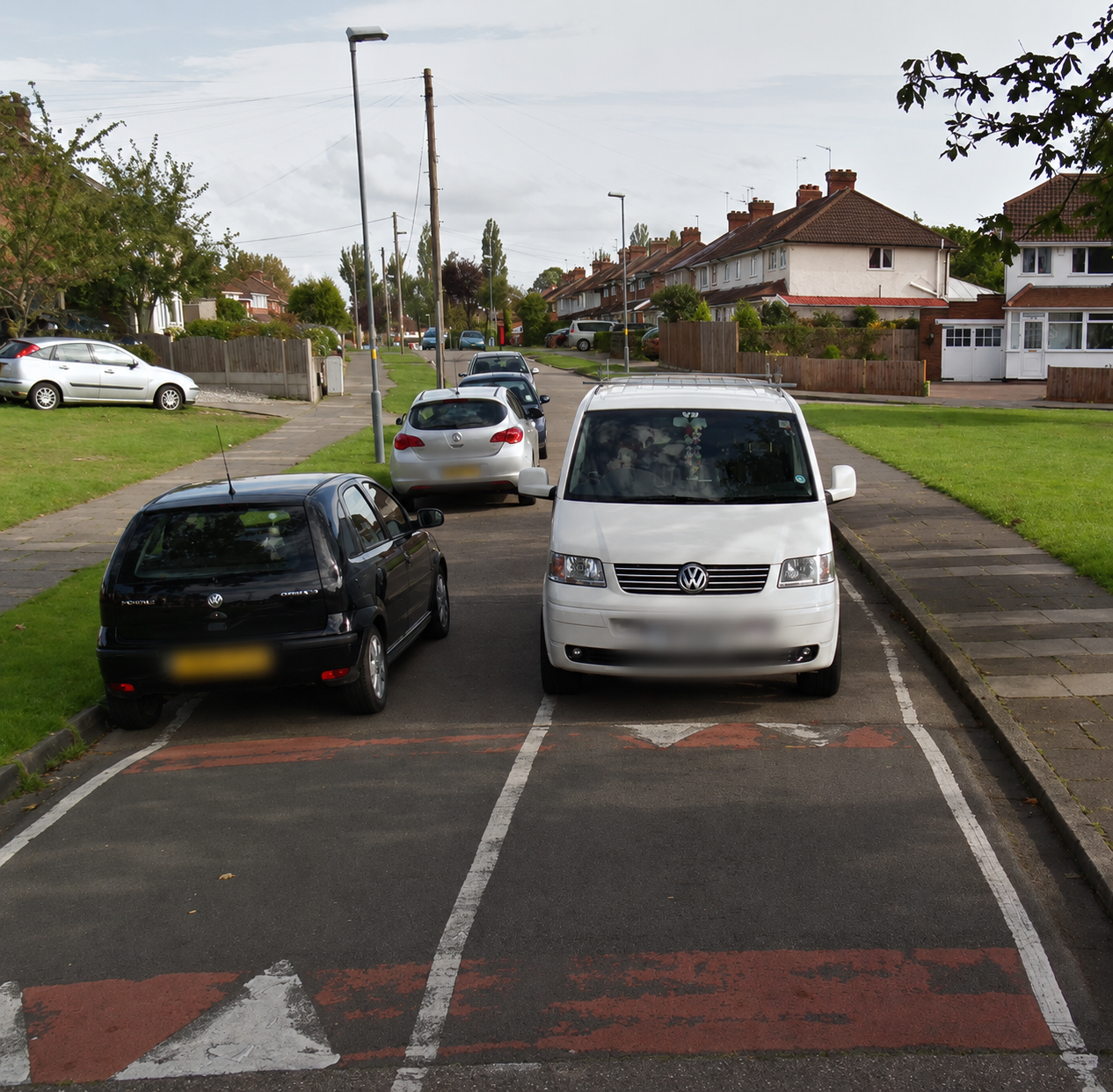
Your side, your wait
If the obstruction is on your side, plan on stopping early rather than hoping the other driver gives way instead.
A good waiting point keeps you flexible
Choose somewhere the road stays open and you can move off cleanly, not a spot that traps you against the obstruction.
Key steps
- 1 Read the road early and recognise when the parked vehicles or narrowing are on your side rather than the oncoming driver's.
- 2 Slow down in good time and choose a waiting point where the car won't block the road or force a last-second stop.
- 3 Stop under control with enough room for the oncoming driver to pass comfortably - not so tight that you're trapped if they hesitate.
- 4 Keep observing while you wait, then move off smoothly only once the road ahead is genuinely clear again.
Read moreShow less
Common mistakes
Leaving the decision too late
Decide you need to stop as soon as you spot the obstruction, so you have a proper waiting place instead of a rushed one.
Stopping too close to the obstruction
Leave enough clearance to keep the car straight and to still have room to move if you need to.
Moving off before the road is fully clear
Wait until the oncoming vehicle has actually passed, not just started to - a gap that looks clear can still have another vehicle behind it.
Read moreShow less
Example scenarios
Illustrative, AI-generated examples - not real photographs.
 Avoid
Avoid
Highway Code
This lesson is a revision aid, not a replacement for The Highway Code.
Rule 163
Give way to oncoming vehicles before passing parked vehicles or other obstructions on your side of the road.
Read on GOV.UKRule 167
Do not overtake or push through where you might come into conflict with other road users, such as where the road narrows.
Read on GOV.UKRead moreShow less
More in Meeting traffic
Proceeding when you have priority
Having priority isn't permission to go - it only becomes safe to proceed once you can see the other driver has actually…
Managing a sequence of give-way points
On a residential street with several give-way points in a row, each one is a separate decision - working through the se…
Giving way where neither side has priority
A narrow bridge like this doesn't come with a sign to settle who goes first - there's no obstruction on one side to han…