This video has no narration.
Practical test
Why it matters
This checks judgement and planning as much as priority itself - forcing through or hesitating once it's safe are both marked the same way as misjudging priority in the first place.
What to look out for
Priority needs confirming, not assuming
The obstruction being on their side tells you who should give way. It doesn't tell you they've actually seen it that way - wait for the yield.
Controlled, not fast
The goal is a smooth, committed pass once the gap is clearly yours, not getting through quickly.
Key steps
- 1 Read the road early and confirm the obstruction (parked cars, narrowing) is on the oncoming driver's side, not yours - that's what gives you priority in the first place.
- 2 Approach at a speed that still lets you stop if the situation changes, even though you expect to keep going.
- 3 Wait for clear evidence the oncoming driver is slowing or has stopped for you - priority is a right, not a guarantee they've noticed it.
- 4 Once it's clearly safe, drive through with steady speed and smooth steering, then return to normal driving once the gap has opened up behind you.
Read moreShow less
Common mistakes
Treating priority as permission to rush
Keep the approach controlled and stay ready to stop until the other driver has clearly given way - priority only helps once it's actually been recognised.
Hesitating after they've already stopped
Once it's obviously safe, go positively - lingering after someone has yielded just confuses them.
Squeezing too close to the obstruction
Keep the car balanced through the middle of the usable space rather than hugging either the parked vehicles or the kerb.
Read moreShow less
Example scenarios
Illustrative, AI-generated examples - not real photographs.
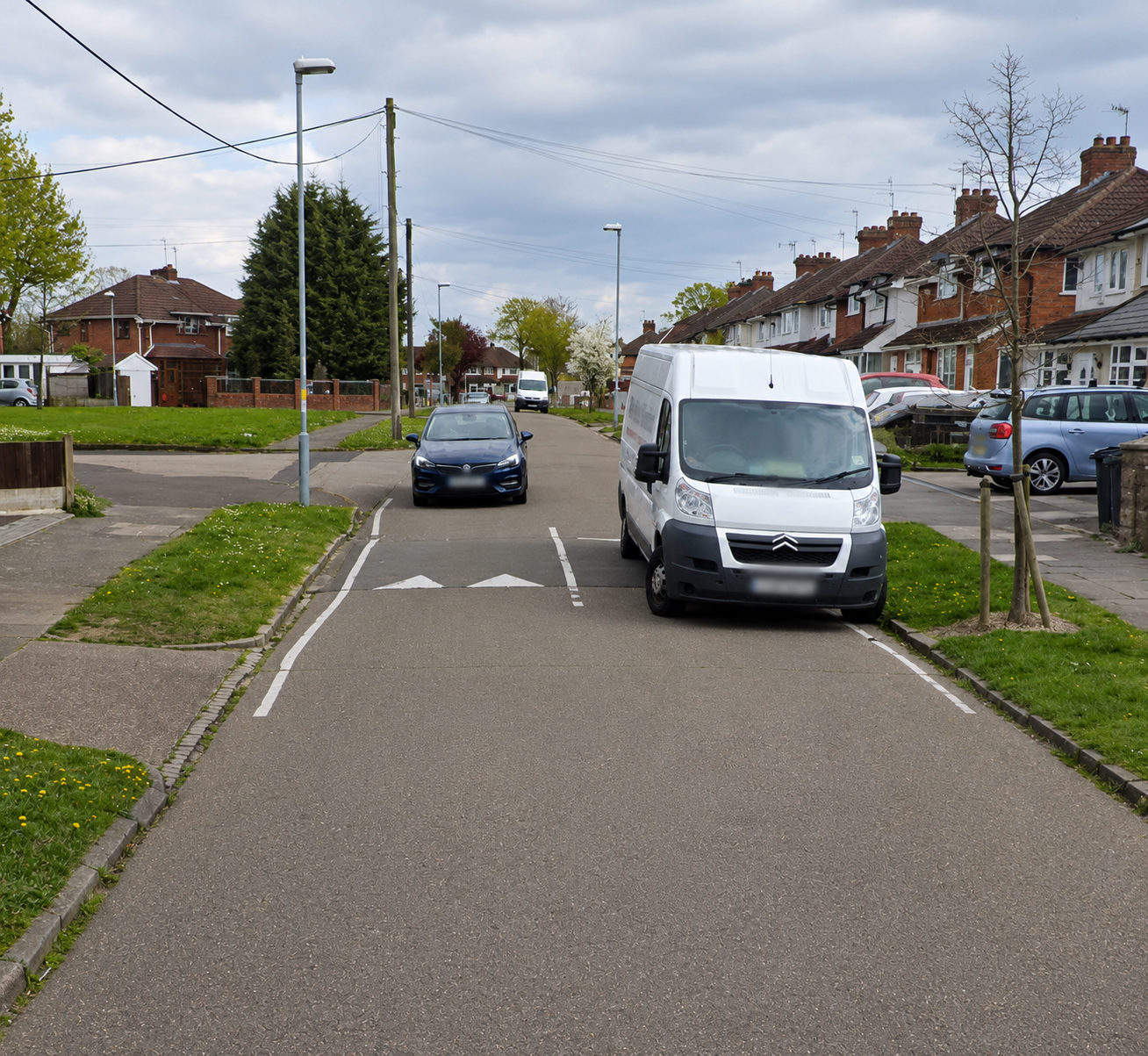 Avoid
Avoid
Highway Code
This lesson is a revision aid, not a replacement for The Highway Code.
Rule 163
Give way to oncoming vehicles before passing parked vehicles or other obstructions on your side of the road.
Read on GOV.UKMore in Meeting traffic
Stopping when you do not have priority
If the obstruction is on your side, the decision to stop is yours to make early - waiting until the last moment turns a…
Managing a sequence of give-way points
On a residential street with several give-way points in a row, each one is a separate decision - working through the se…
Giving way where neither side has priority
A narrow bridge like this doesn't come with a sign to settle who goes first - there's no obstruction on one side to han…