 Driving Mastery
Driving technique
Which lane should you use on a roundabout?
The Highway Code lane and signalling rules for roundabouts - left, ahead and right - and the signal most learners forget.
See the roundabout lessonsQuick answer
- Turning left: unless signs or markings say otherwise, signal left, approach in the left lane, and keep left all the way round.
- Going ahead: unless signs or markings say otherwise, pick the appropriate lane - you should not normally need to signal on approach - then signal left after you pass the exit before yours.
- Turning right: unless signs or markings say otherwise, signal right, approach in the right lane, keep right, then signal left after you pass the exit before yours.
- Give way to traffic coming from your right, unless signs, road markings or traffic lights direct otherwise.
Roundabouts: choosing the correct lane
Most learners can recite the lane rules and still get them wrong under pressure, because the hard part is not the lane you start in - it is knowing when to signal once you are on the roundabout. That single mistake causes more hesitation from the drivers behind you than any wrong lane choice does.
Roundabout lane rules: left, ahead and right
-
Turning left (first exit)
Signal left on approach, use the left-hand lane, keep left on the roundabout, and keep signalling left until you leave.
-
Going ahead
You should not normally need to signal on approach. Select the appropriate lane, stay in it until you need to alter course, then signal left after you have passed the exit before the one you want.
-
Turning right or going full circle
Signal right on approach, use the right-hand lane, keep right until you need to change lanes, then signal left after you have passed the exit before yours.
Worth knowing: the lane and signalling rules here - 184 to 187 - are worded as advice rather than law. One roundabout rule is not: rule 188 says all vehicles MUST pass round the central markings of a mini-roundabout, except large vehicles physically incapable of it, and that one is backed by legislation. That does not make the advisory ones optional. The DVSA's own list of things that get marked on test includes "signalling right at a roundabout when you want to go ahead" and "signalling too late for the signal to be effective" - so getting this wrong is marked whether or not the underlying rule is law. It does, though, explain why you will see drivers treating lane discipline as negotiable.
How to read a roundabout like a clock face
The rules above tell you what to do once you know which exit you want. This is how I get learners to that decision at 30mph, with a car behind them, on a roundabout they have never seen before.
Picture the roundabout as a clock face with your entry at six o'clock. If the exit you want sits on the left half of the clock, take the left lane. If it sits on the right half, take the right lane. That is the whole model. For a left or right exit it lands on the same answer the Highway Code gives - it just gives you a way to reach it while you are driving rather than from memory. Straight ahead at twelve is the case it does not settle on its own, and rule 186 handles that one separately: select the appropriate lane on approach and follow any markings.
The sign tells you the layout while you can still choose a lane
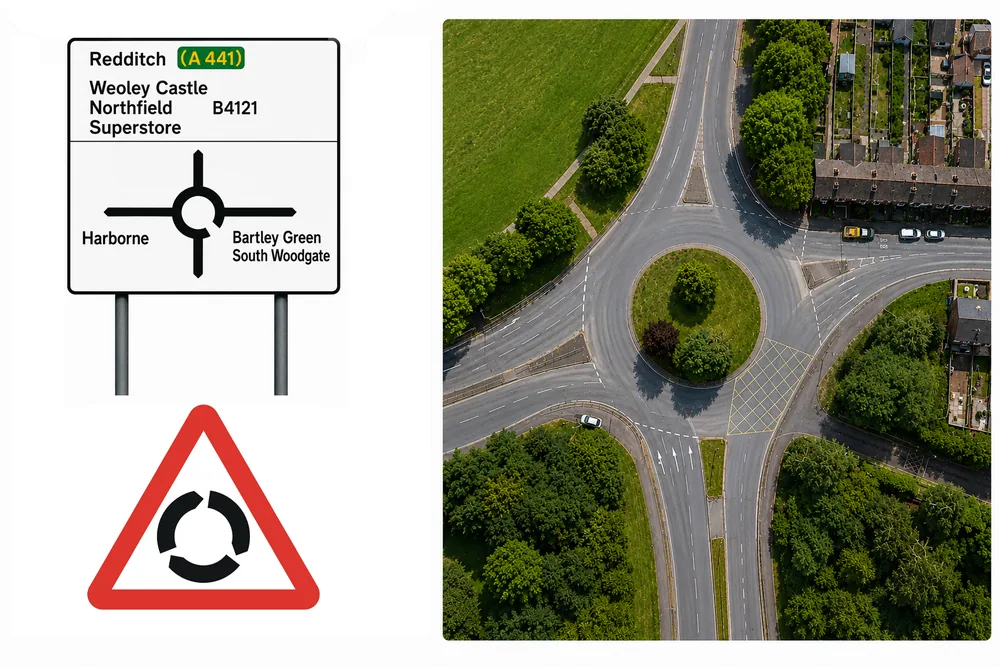
Same roundabout, two exits, two lanes
-
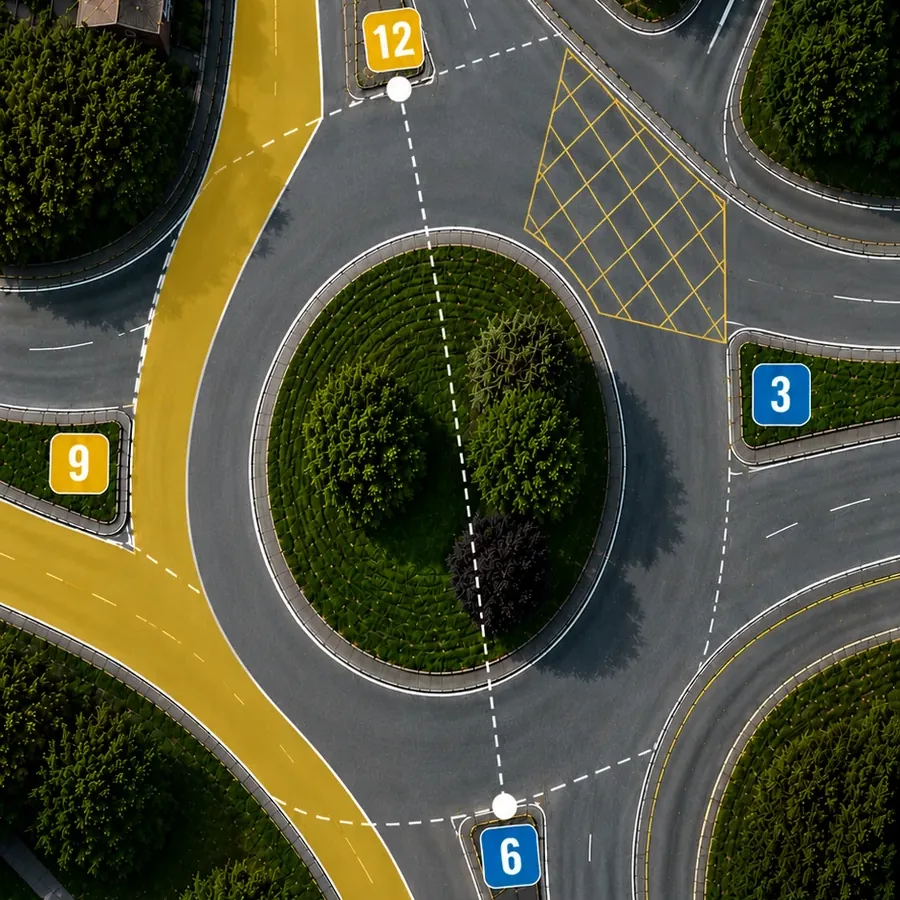
1 Left half of the clock: the nearside lane, round the outside, out at nine. At this roundabout the same carriageway runs on to the twelve o'clock exit as well - and twelve is the case the clock face does not settle by itself.
-
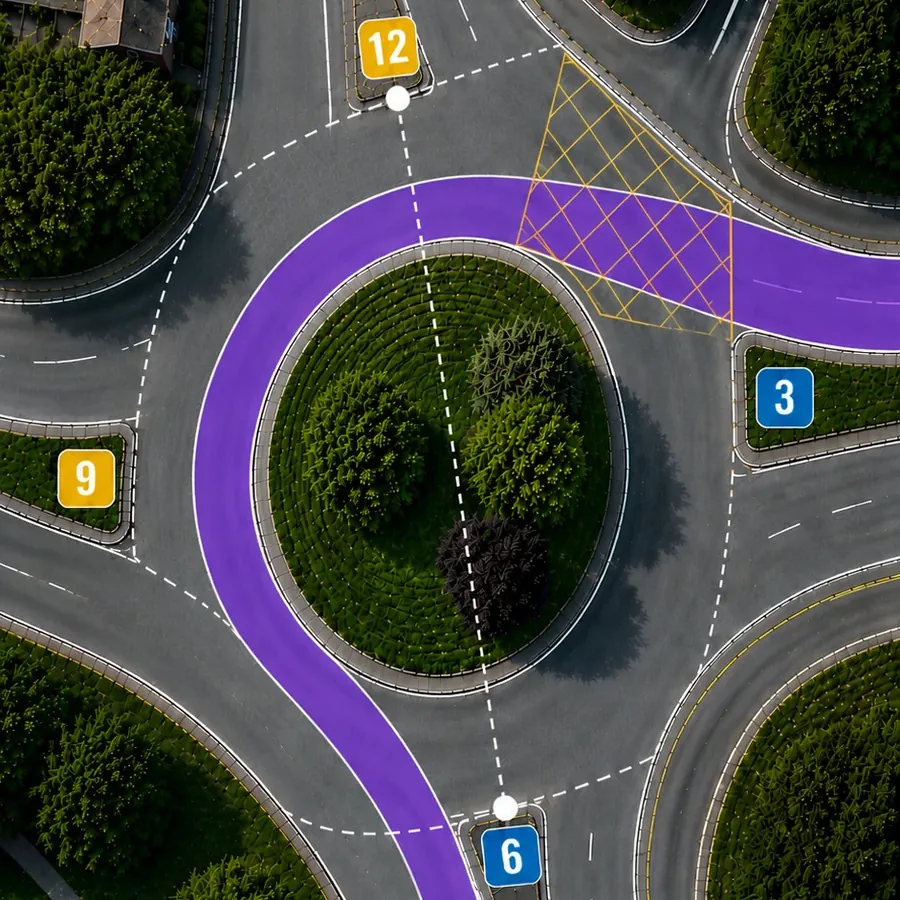
2 Exit at three - the right half. Right lane, and stay right until you come off.
-
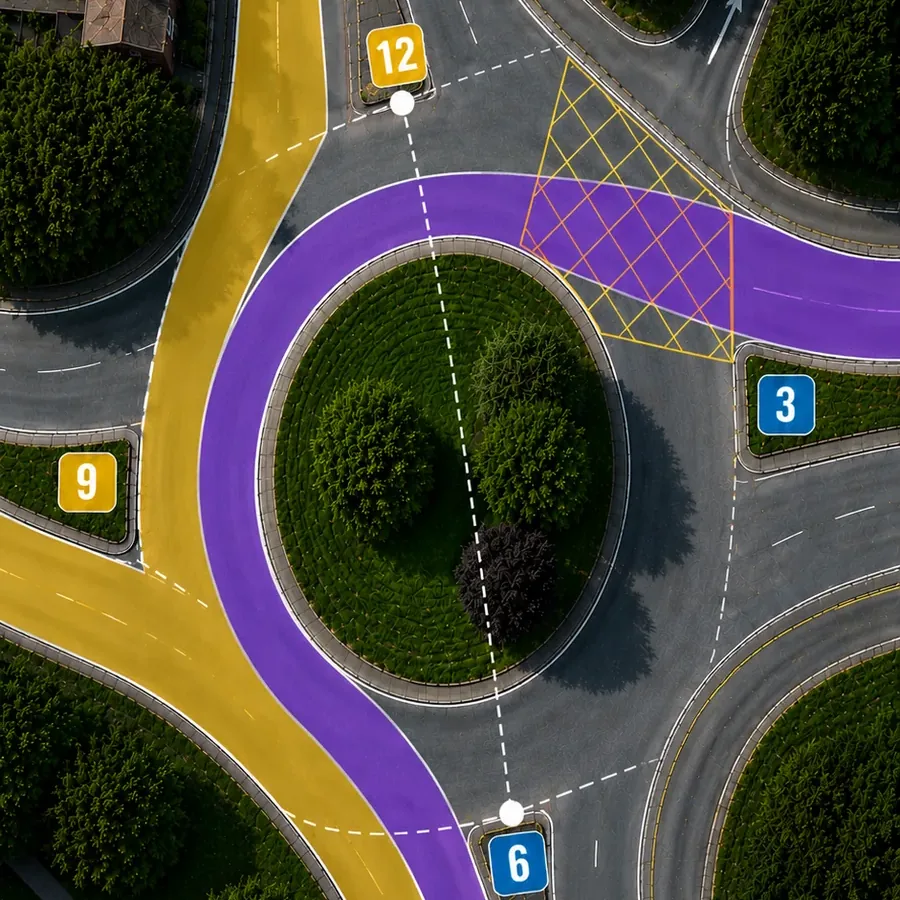
3 Both together. Once you know which half your exit is on, the lane follows - with straight ahead at twelve the one case you read off the markings instead.
What to do when there is no lane sign on approach
Plenty of roundabouts show you nothing on approach. Smaller urban ones, estate roads and many mini-roundabouts have no map sign at all, and the clock face is no use if you cannot see the layout before you commit to a lane. That is normal, and it is worth having a plan for rather than being caught out by it.
-
Read the road, not the sign
Lane arrows painted on the approach are the authority anyway. Where they exist they override any general rule and any mental model - follow them.
-
Treat unknown as straight ahead
The Highway Code does not set a default here - rule 186 says only to select the appropriate lane on approach. What I teach is that with no sign and no markings the left lane is the safer choice: it keeps you out of the path of anyone turning right and leaves your options open.
-
Go round again rather than cut across
If you realise late that your exit is on the right half, stay on the roundabout and come round rather than changing lanes across someone. An extra lap costs you seconds; changing lanes alongside someone who is already there costs a great deal more. A mini-roundabout is the exception: rule 188's own warning is that there is less space to manoeuvre and less time to signal, so rather than going round one again, carry on to the next junction and turn round there.
-
Look at the roundabout itself
As you approach you can usually see the exits and the lane markings on the roundabout ahead of you. That is late information, but it is real information - use it to confirm or correct the choice you made from the sign.
Multi-lane roundabouts: three lanes, four lanes and spirals
Everything above assumes a roundabout with two lanes on approach. Add a third or a fourth and the clock face still helps you place your exit - but the lane markings, not the general rule, decide which lane you take.
-
Three lanes: the middle lane usually serves the middle exits
Read the painted arrows in each lane on approach. A three-lane entrance normally puts left-only in the nearside lane, ahead in the middle, and right plus full circle in the offside lane - but that is a convention, not a rule, and the paint on the road is what counts.
-
Four or more lanes: the Highway Code changes its advice
Rule 186 says that where there are more than three lanes at the entrance to a roundabout, you should use the most appropriate lane on approach and through it. That is deliberately looser wording, because a junction that size is signed and marked individually.
-
Spiral roundabouts: stay in your lane and let it carry you out
The lane markings curve outwards and feed you to an exit. Changing lanes part-way round is the thing to avoid here - if you have picked the right lane on approach, the paint does the rest.
-
If you have already committed to the wrong lane, follow it
Take whatever exit that lane feeds, then come back round. Cutting across a lane of moving traffic on a large roundabout is far more dangerous than an extra minute of driving.
Types of roundabout you will meet on test
The lane rules are the same at each; what changes is how much room you get to apply them. Mini-roundabouts give you almost no approach distance, so the decision has to be made earlier. Standard roundabouts are where the clock face is easiest to use. Multi-lane and spiral roundabouts hand the decision to the road markings. Each of these has its own step-by-step lesson in the Driving Skills library.
Frequently asked questions
When do you signal left on a roundabout?
It depends on which exit you are taking. If you are turning left at the first exit, signal left on approach and keep signalling left until you leave. For every other exit - going ahead, turning right, or going full circle - signal left only after you have passed the exit before the one you want. Signalling as you approach your own exit is too late for drivers waiting to enter; signalling before that is too early and invites them to pull out in front of you.
Do you signal when going straight ahead on a roundabout?
You should not normally need to signal on approach. Signal left once you have passed the exit before the one you want.
Who has priority on a roundabout in the UK?
Traffic coming from your right, unless signs, road markings or traffic lights direct otherwise. That is rule 185.
How does a multi-lane roundabout work?
The same lane rule applies as on any roundabout - left lane for a left exit, right lane for a right exit - but painted lane arrows override it. Read the arrows on approach, pick the lane that feeds your exit, and stay in it the whole way round.
Which lane do you use on a three-lane roundabout?
Whichever lane the painted arrows say serves your exit. As a rough convention the nearside lane is left-only, the middle serves the intermediate exits and the offside lane serves right turns and full circle - but the markings decide, not the convention.
Which lane for the second exit on a roundabout?
Rule 186 sorts exits by direction, not by number, so it depends on where the second exit actually sits. If it is straight ahead - the usual case on a four-exit roundabout - it is an intermediate exit: select the appropriate lane on approach, and you should not normally need to signal until you have passed the exit before yours. If the second exit is effectively a right turn, which is common on a three-exit roundabout, follow the right-turn case instead: signal right on approach and use the right-hand lane. Where nothing is marked, the left lane is the usual choice for straight ahead - but wherever there are lane arrows, they decide.
What is a filter lane on a roundabout?
A lane that leaves the roundabout before the give-way line, letting you take an exit without joining the roundabout itself. It is marked out and usually signed; if you are not taking that exit, stay out of it.
Related learning
Free video library
38 more driving lessons, filmed on real UK roads
Every junction type, roundabout and manoeuvre, filmed on the road rather than drawn. The written lessons and all 38 videos are open to everyone, with no account needed.
Browse the free Driving Skills libraryPart of a topic guide
Driving technique on the road
Part of Driving Mastery's practical driving guide, covering the on-road judgement calls and car control learners find hardest - roundabout lanes and gaps, box junctions, meeting traffic, hill starts and gear changes.
Why you miss gaps at roundabouts
Missing gaps is usually a preparation problem, not a judgement problem. How to have the car ready to move while you are still watching the traffic.
Turning right in a yellow box junction: what the Highway Code actually says
You MUST NOT enter a box junction until your exit is clear - except when turning right. The one exception, and the moment it stops applying.
Meeting oncoming traffic: who actually gives way?
There is a Highway Code rule for this, and almost nobody can find it - because it is filed under Overtaking. What rule 163 actually says, and why it is still a judgement call.
How to do a hill start
A hill start demonstrated from the driver's seat and the pedals: finding the biting point, when the brake comes off, and the checks that come before you go.
How to change down gears smoothly
Brake to the speed you want, then take the gear that suits it - and why you can drop from fifth to second without touching the gears in between.
Driving at night and in bad weather: lights, rain, fog and ice
The lights the law requires after dark, when fog lights are illegal, how far to stay back in rain and on ice, and what bad weather means for your driving test.
Driving on country roads and national speed limit roads
How to drive rural and national speed limit roads: bends, horses, walkers with no pavement, tractors, overtaking, and why your driving test will probably include them.
What to do if you stall, and how a stall is marked on your test
Why a manual car stalls, the safe way to restart, what changes at a junction or on a hill, and what DVSA's own guidance says about how a stall is marked.
Driving Mastery's learner guidance is written and reviewed by Niall Cullen, a UK approved driving instructor, so it stays practical, safe, and grounded in real driving lessons.