This video has no narration.
Practical test
Why it matters
Examiners are watching whether you treat the give-way point where the filter lane rejoins as a genuine junction, not a formality - misreading it as automatic priority is exactly the kind of mistake this skill is testing.
What to look out for
Filter lane means route, not priority
The lane tells you where the road goes. Where it rejoins is a give-way point - you must give way to traffic already there, the same as joining from any side road.
Commit early, hold the line
Once you've chosen the filter lane, keep the steering smooth and avoid drifting toward the main roundabout lane.
Key steps
- 1 Identify the filter lane from the lane markings and layout of the roundabout itself, not from signs - many mini-roundabouts have no advance sign for a filter lane at all, so the marking on the road is what tells you it's there.
- 2 Check mirrors and signal left - Rule 186 requires a left signal on approach for a first exit, filter lane or not - then move into the lane in good time rather than cutting across at the last moment.
- 3 Keep your speed low enough to judge pedestrians, cyclists, and traffic from the right, even though the filter lane feels like a more direct route.
- 4 Treat the point where the filter lane rejoins the road as a junction: there's a give-way marking there, and Rule 172 means you MUST give way to traffic already on the roundabout or exit road before you continue - only build speed once you've actually given way and the road is clear.
Read moreShow less
Common mistakes
Treating the filter lane as automatic priority
The filter lane sets your route, not your right of way. Where it rejoins the road is a give-way point like any other junction - you MUST give way to traffic already there, not just check and continue.
Assuming a sign will tell you when to move over
Many mini-roundabouts have no advance sign for a filter lane - read the lane markings on the road itself and get into position in good time, rather than waiting for a sign that might not come or cutting across at the last moment.
Carrying too much speed through the filter
Keep the car slow enough to respond if the lane narrows, a crossing appears, or traffic ahead slows unexpectedly.
Read moreShow less
Example scenarios
Illustrative, AI-generated examples - not real photographs.
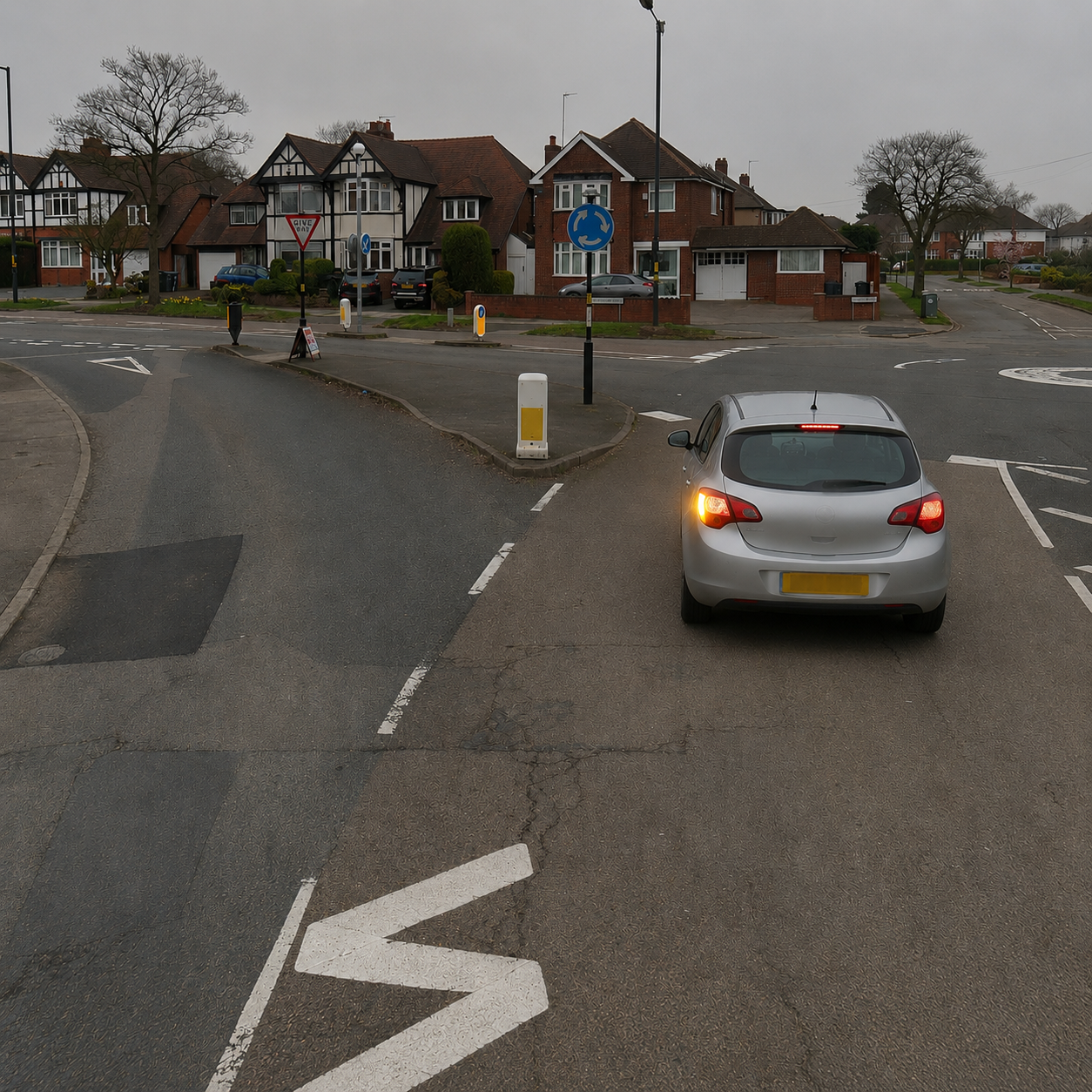 Avoid
Avoid
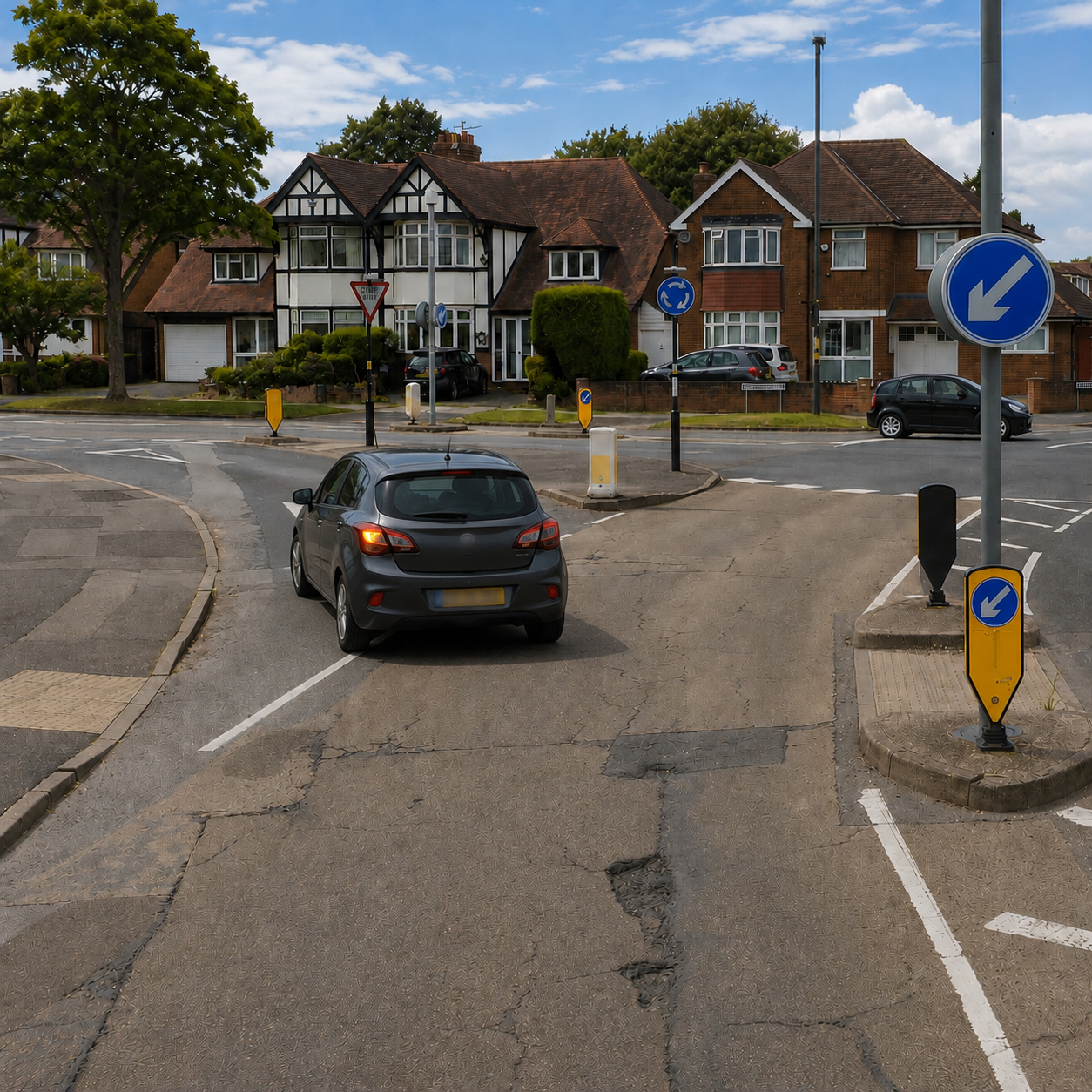 Do
Do
Read moreShow less
Highway Code
This lesson is a revision aid, not a replacement for The Highway Code.
Rule 184
On approach, use Mirror-Signal-Manoeuvre at all stages, decide as early as possible which exit you need, give an appropriate signal (see Rule 186), and time your signals so as not to confuse other road users.
Read on GOV.UKRule 186
Unless signs or markings indicate otherwise, choose your lane and signal by your exit: first exit - signal left and approach in the left lane; going ahead - no signal on approach, then signal left after the exit before yours; right or full circle - signal right and approach in the right lane, then signal left after the exit before yours.
Read on GOV.UKRule 172
The approach to a junction may have a 'Give Way' sign or a triangle marked on the road. You MUST give way to traffic on the main road when emerging from a junction with broken white lines across the road.
Read on GOV.UK