 Driving Mastery
Theory test basics
How many questions are in the UK theory test?
A clear guide to the number of multiple-choice questions in the UK car theory test and how to practise for them.
Try 25 free practice questionsQuick answer
- The UK car theory test has 50 multiple-choice questions.
- You have 57 minutes to answer them.
- You need 43 out of 50 to pass the multiple-choice section.
- After the questions, you also take the hazard perception test.
The UK car theory test has 50 multiple-choice questions. You answer them on a computer before moving on to the hazard perception part of the test.
The number matters because it shapes how you revise. You are not preparing for a handful of facts; you are preparing to answer a broad mix of road rules, signs, safety, attitude, hazards, documents, and vehicle questions under time pressure.
A 50-question mock test needs steady topic knowledge
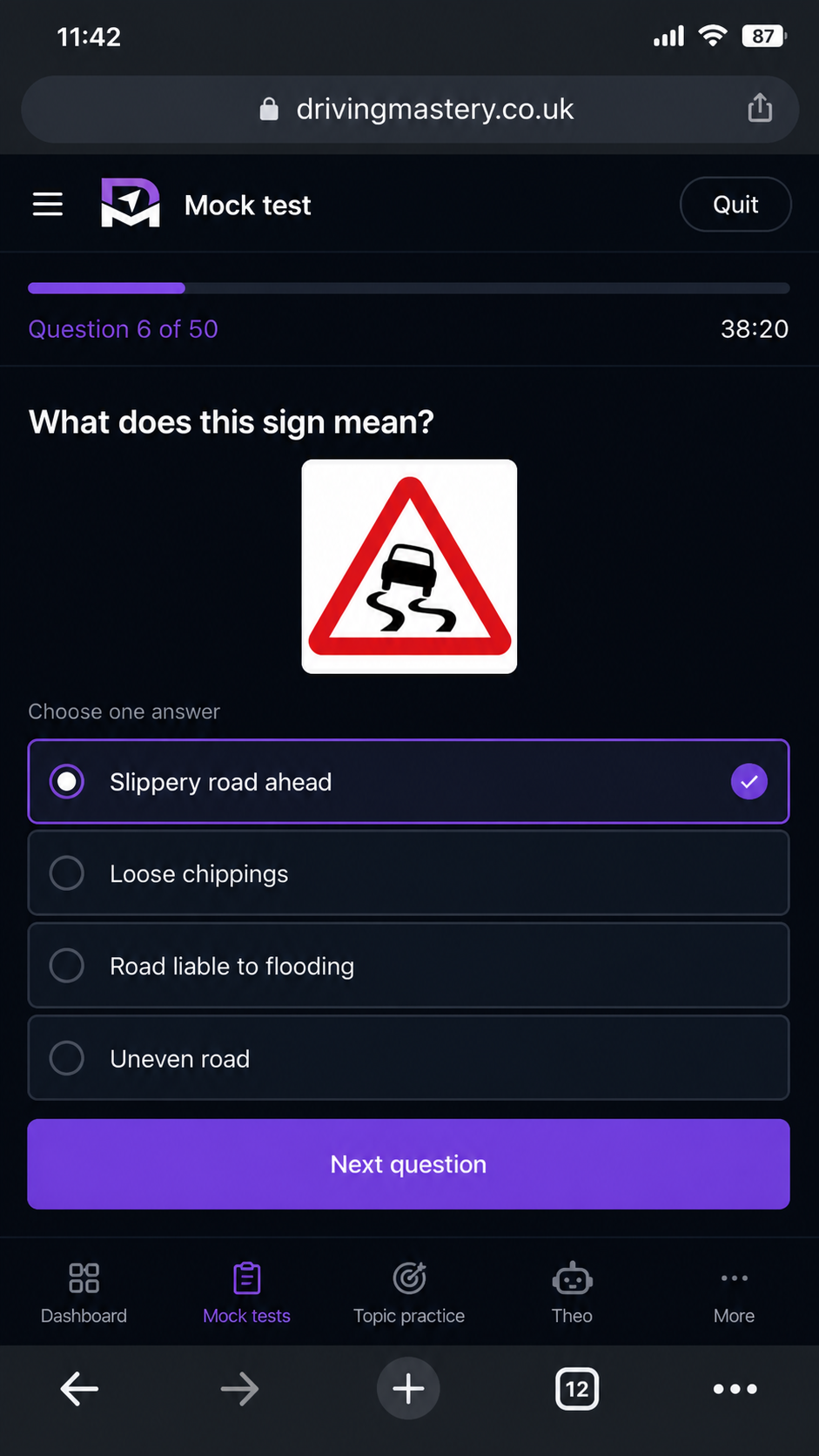
How long do you get for the 50 questions?
For the car theory test, you get 57 minutes for the multiple-choice section. That is enough time for most learners, but it can feel short if you spend too long on difficult questions or if you have not practised reading question wording carefully.
A sensible practice target is to finish a 50-question mock test with a few minutes spare, while still checking every question properly. Speed helps, but accuracy matters more.
What the multiple-choice section tests
- Your understanding of road rules and safe driving decisions.
- Your ability to recognise signs, markings, warnings, and restrictions.
- Your awareness of hazards, other road users, vehicle handling, and environmental conditions.
- Your ability to apply knowledge to short driving situations rather than only remember facts.
Are all 50 questions equally important?
In the test, each multiple-choice question is worth one mark. In revision, however, not every mistake tells you the same thing. Getting one unusual question wrong is different from repeatedly missing rules of the road, road signs, stopping distances, or vulnerable road user questions.
That is why reviewing mistakes by category is more useful than only looking at your final score. A 44 out of 50 can still hide a weak topic that may cause problems next time.
How to use this when revising
Because there are 50 questions, aim to build consistent knowledge rather than memorising single answers. Use short practice sessions, review mistakes, and retest weak categories until your scores are stable.
A simple way to practise 50-question tests
-
Step 1
Learn one theory topic first, such as road signs or safety margins.
-
Step 2
Answer focused questions on that topic and review every mistake.
-
Step 3
Take a mixed mock test so you practise switching between topics.
-
Step 4
Record the categories behind your wrong answers, not just your final score.
What score should you aim for in practice?
The pass mark is 43, but your practice target should be higher. Aim for repeated scores in the high 40s before test day. That gives you a buffer if a question is worded differently, if nerves affect you, or if one topic appears more often than expected.
Frequently asked questions
How many multiple-choice questions are in the car theory test?
There are 50 multiple-choice questions in the UK car theory test.
How long do you get for the theory test questions?
For the car theory test, you get 57 minutes for the multiple-choice section.
Do you take hazard perception on the same day?
Yes. The theory test appointment includes the multiple-choice questions and the hazard perception test.
Should I only practise full 50-question mock tests?
No. Full mock tests are useful, but focused category practice is better when you need to fix weak areas.
Related learning
When you are ready to revise
Theory Access — £5.99, one payment
Work through the question bank by category, see every question you got wrong and why, and sit timed mock tests in the real format. No subscription.
Not sure yet? The free 25-question diagnostic needs no account and shows you which categories are weakest.
See what Theory Access includesPart of a topic guide
UK theory test guide
Part of Driving Mastery's UK theory test guide for learner drivers preparing for the multiple-choice and hazard perception test.
How many marks do you need to pass the theory test?
Understand the car theory test pass mark, what 43 out of 50 means, and how to build a safer revision target.
What happens if you fail your theory test? Retakes, waiting times and what to do next
Failed your UK theory test? Learn what happens next, how soon you can retake it, what you need to pass, and how to revise before booking again.
How to revise for the theory test properly
A practical theory test revision method for learner drivers who want to understand topics, remember rules, and pass with confidence.
What are the 14 DVSA theory test categories?
Learn the DVSA theory test topic categories and how to use them to organise your revision.
How long does the UK theory test take?
Learn how long the UK car theory test takes, how the 57-minute multiple-choice section works, and how to manage your time on test day.
How much is a theory test? UK cost, price and retake fees
The UK car theory test costs £23 when booked through GOV.UK. Learn what the price includes, how retakes work, and how to avoid extra booking fees.
Book theory test UK: how to book your car theory test online
Book your UK car theory test through GOV.UK with the right details ready. Learn the official route, what you need, how much it costs, and how changes work.
What do you need to bring to your theory test?
A simple UK theory test checklist covering the licence you need, when to arrive, and what happens if you forget it.
Can you change or cancel your theory test?
Learn when you can change or cancel a UK theory test, the 3 full working days rule, and how to use extra time well.
How long does a theory test pass last?
Your theory pass certificate lasts two years, and the practical has to be passed inside them. What the deadline covers, what happens if it runs out, and how to keep it from catching you.
Can you get extra time or support in the theory test?
A voiceover, extra time, someone to read the screen or reword the questions, BSL and a hearing loop - what DVSA offers, what proof it asks for, and why you ask when you book.
What is the hazard perception test?
A learner-friendly explanation of the UK hazard perception test, what it checks, and how it fits into the theory test.
How many hazard perception clips are in the theory test?
Learn how many clips are in the UK car hazard perception test, how many hazards are scored, and what that means for practice.
What score do you need to pass hazard perception?
Learn the UK car hazard perception pass mark, how the 75 marks work, and what score to aim for in practice.
How to practise hazard perception properly
A practical hazard perception revision method for learner drivers who want to improve timing, awareness, and confidence.
Why do people fail hazard perception?
The most common reasons learner drivers fail hazard perception and how to fix late clicks, missed hazards, and over-clicking.
Check your current question baseline
Use a short mock test to see which topics would make the 50-question section difficult before you move into full mocks.
Start a mock testStrengthen the theory topics first
Build the knowledge behind common question areas so your mock-test score improves for the right reason.
Study modulesPart of Theory Access, £5.99 one-time
Driving Mastery's learner guidance is written and reviewed by Niall Cullen, a UK approved driving instructor, so it stays practical, safe, and grounded in real driving lessons.