This video has no narration.
Practical test
Why it matters
Signalling by the exit's number instead of its actual position is a common fault. Examiners are watching whether your signal matches where the exit really is - and when it appears.
What to look out for
Read the exit's position, not its number
Roughly straight ahead is an intermediate exit - no approach signal. Past 12 o'clock is an exit to the right - signal right and approach in the right-hand lane. A second exit can be either, depending on the layout.
Your signal is a promise about where you leave
An early left signal tells a driver waiting at the first exit that you're turning in there, and they may pull out in front of you. Timing it after that exit keeps the message honest.
Key steps
- 1 Decide on your exit early, then look at where it actually sits on the roundabout: roughly straight ahead, or round past 12 o'clock to the right? That's what sets your lane and signal - not the fact that it's the second one.
- 2 If it's straight ahead, it's an intermediate exit: select the appropriate lane - normally the left-hand one - and don't signal on the approach.
- 3 If it sits past 12 o'clock, treat it as a right turn: approach in the right-hand lane and signal right, unless signs or markings tell you otherwise.
- 4 Check your mirrors, slow down progressively, and give priority to traffic approaching from your right - only enter once the gap is genuinely safe.
- 5 Whichever applies, hold a steady position around the roundabout - there are no lane markings on the roundabout itself, only on the approach - then check mirrors and signal left once you've passed the exit before yours, and leave smoothly onto the new road.
Read moreShow less
Common mistakes
Assuming a second exit never needs an approach signal
The exit's number doesn't set the signal - its direction does. A second exit that sits past 12 o'clock is a right turn, and it needs a right signal on approach the same as any other.
Signalling left too early
Wait until you've actually passed the exit before yours. Signal any sooner and a driver waiting at the first exit may pull out expecting you to leave there.
Approaching too fast to judge the right
Slow down early enough that you can genuinely assess traffic coming from your right, instead of arriving at the give-way line still deciding.
Read moreShow less
Example scenarios
Illustrative, AI-generated examples - not real photographs.
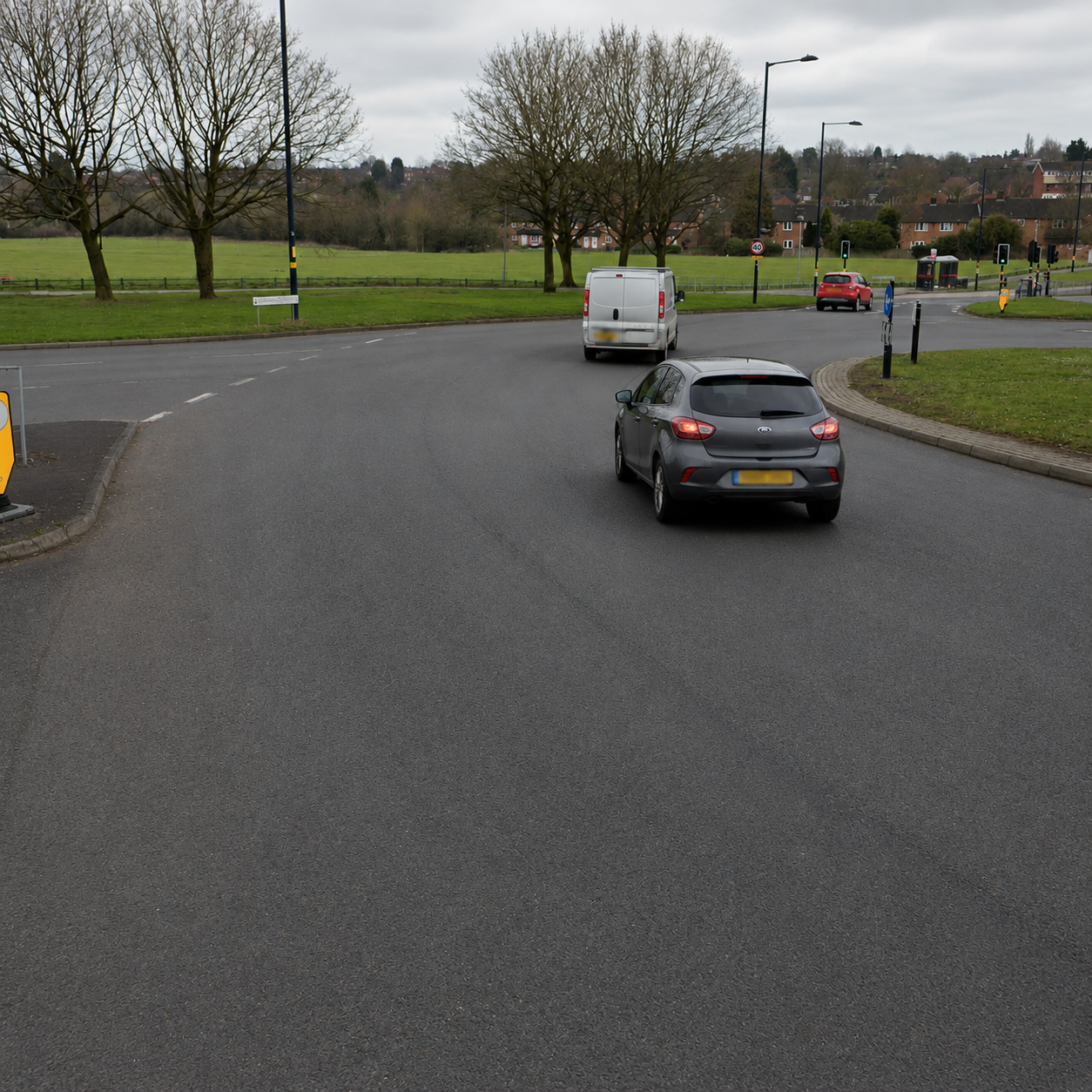 Avoid
Avoid
Highway Code
This lesson is a revision aid, not a replacement for The Highway Code.
Rule 184
On approach, use Mirror-Signal-Manoeuvre at all stages, decide as early as possible which exit you need, give an appropriate signal (see Rule 186), and time your signals so as not to confuse other road users.
Read on GOV.UKRule 185
Give priority to traffic approaching from your right, unless directed otherwise by signs, road markings or traffic lights.
Read on GOV.UKRule 186
Unless signs or markings indicate otherwise, choose your lane and signal by your exit: first exit - signal left and approach in the left lane; going ahead - no signal on approach, then signal left after the exit before yours; right or full circle - signal right and approach in the right lane, then signal left after the exit before yours.
Read on GOV.UKRead moreShow less
More in Standard roundabouts
Taking the first exit at a standard roundabout
The one exit where the signal isn't a judgement call - a first exit always means a left signal on approach, held all th…
Taking the third exit at a standard roundabout
A third exit means holding your position through more of the roundabout than a first exit - the signal timing and lane …