Safety Margins
This product includes the Driver and Vehicle Standards Agency (DVSA) revision question bank.
Free mock test
Question 1 of 10
10 questions across theory topics. Create an account after results to save progress.
Safety Margins
On what type of road surface may anti-lock brakes be ineffective?
Poor contact with the road surface could cause one or more of the tyres to lose grip on the road. This is more likely to happen when braking in poor weather conditions and when the road has a loose, slippery or uneven surface.
Safety Margins
Why should you keep well to the left as you approach a right-hand bend?
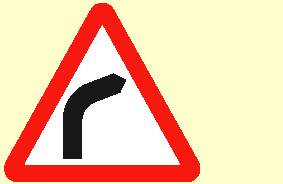
Keeping to the left as you approach right-hand bends will give you an earlier view around the bend and allow you to see any hazards sooner. It also reduces the risk of collision with any oncoming vehicle that may have drifted over the centre line while taking the bend.
Safety Margins
What's the main benefit of driving a four-wheel-drive vehicle?
By driving all 4 wheels, the vehicle has maximum grip on the road. This grip is especially helpful when travelling on slippery or uneven surfaces. However, having four-wheel drive does not replace the skills you need to drive safely.
Safety Margins
How can you use your vehicle's engine as a brake?
When driving on downhill stretches of road, selecting a lower gear gives increased engine braking. This will prevent excessive use of the brakes, which become less effective if they overheat.
Safety Margins
You're about to start a journey in freezing weather. What part of your vehicle should you clear of ice and snow?
Driving in bad weather increases your risk of having a collision. If you absolutely have to travel, clear your lights, mirrors, number plates and windows of any snow or ice, so that you can see and be seen.
Safety Margins
What will help you to move off on a snowy surface?
If you attempt to move off in a low gear, there'll be more torque (turning force) at the driven wheels than if you use a higher gear. More torque makes it easier for the tyres to lose grip and so spin the wheels.
Safety Margins
You're following other vehicles in fog. You have your headlights on dipped beam. What else can you do to reduce the chances of being in a collision?
When it’s foggy, use your headlights on dipped beam. This will help you see and be seen by other road users. If visibility is seriously reduced, consider using front and rear fog lights if you have them. Keep to a sensible speed and do not follow the vehicle in front too closely. If the road is wet and slippery, you’ll need to allow twice the normal stopping distance.
Safety Margins
What should you do when you're overtaking a motorcyclist on a windy day?
In strong winds, riders of two-wheeled vehicles are particularly vulnerable. When you overtake them, allow plenty of room. Check to the left as you pass to make sure they're safe.
Safety Margins
What should you do when you're driving in snowy conditions?
In snowy conditions, be careful with the steering, accelerator and brakes. Braking sharply while you're driving on snow is likely to make your car skid.
Review before finishing
You can go back before submitting, or submit as-is.
0/0
answered
0 answered
0 unanswered
0 flagged
This product includes the Driver and Vehicle Standards Agency (DVSA) revision question bank.